What Is the Natural Order of Sport©?
What if the qualities that predict elite athletic success aren't built through years of training—but are already present in every child at birth?
The Natural Order of Sport© is the first comprehensive developmental framework establishing birth—not age 6—as the authoritative origin point of athletic development. Established through Dr. Bradley J. Kayden's 2013 doctoral research and validated over 20+ years of implementation across 15,000+ families, it provides what sports has never had: a principle-based developmental ontology grounded in natural law rather than human convention.
That's the foundational discovery of the Natural Order of Sport©, and it reverses everything we assumed about how athletic talent develops.
The Framework That Made a Field Possible
Every prominent talent development model in sports science starts at age 6. Côté's Developmental Model of Sport Participation. Balyi's Long-Term Athlete Development. Both treat "entry into sport" as the beginning.
But athletic development doesn't begin when a child joins a team. It begins when a baby moves.
The Natural Order of Sport© is the first comprehensive developmental framework establishing birth — not age 6 — as the authoritative origin point of athletic development. Established through Dr. Bradley J. Kayden's 2013 doctoral research and validated over 20+ years of implementation across 15,000+ families, it provides what sports has never had: a principle-based developmental ontology grounded in natural law rather than human convention.
Without it, what happens in the foundational years is a phenomenon. With it, it is a field.
The Central Discovery: Preservation, Not Construction
Every traditional approach to youth sports development operates from the same assumption: athletic success requires building something that isn't there. Build skills. Build toughness. Build discipline.
The Natural Order of Sport© reveals this assumption is backwards.
In 1987, researcher Kuchenbecker surveyed 628 coaches across all levels of competition — youth through professional — and asked what characteristics they valued most in athletes. Three rose above all others: coachability, love of the game, and positive attitude. Not speed. Not strength. Not early specialization. Three relational and psychological qualities that predict success more reliably than any physical attribute.
Now watch any 2-year-old in a movement environment. You'll see all three. Every early learner demonstrates coachability through eagerness to try new things and responsiveness to guidance. Every toddler demonstrates love of movement through intrinsic joy in physical expression. Every young child demonstrates positive attitude through enthusiasm and resilience after difficulty.
These qualities are not absent at the beginning. They are universally present. Traditional sports systems don't fail because they're ineffective at building them. They fail because they are extraordinarily effective at destroying them.
But Athletic Development at Birth? Really?
The skepticism is understandable and worth addressing directly rather than defensively. It arises from a reasonable assumption — that sports requires balls, fields, coaches, and competition, none of which are appropriate for a 4-month-old.
That assumption is correct. But the framework is not claiming infants play sports.
It is claiming that the qualities that make sports possible later in life:
the neurological capacity for intentional movement,
the trust in a movement partner that makes coachability possible,
the intrinsic motivation for physical exploration that becomes love of the game.
They are established or compromised during the first 17 months of life.
Every pediatric neurologist agrees that the first two years represent the most significant period of neurological development in the human lifespan. Motor pathways established during this period determine movement capacity for decades. This is not a sports claim. It is established developmental science.
The Natural Order of Sport© simply names the athletic implications of what pediatric science already knows.
And the parent's role at this stage is not coach. It is movement partner. Tummy time. Reaching games. Supported standing. Exploratory crawling. Responsive, play-based, floor-level interaction that builds the neurological pathways organized instruction will later travel.
The parent on the living room floor does not know they are performing the first act of their child's athletic development. But they are. And Stage 1 is not exempt from early learning sports development — it is where the field's most important work begins.
The deeper structural argument for why birth — not age 2, not age 6 — is the defensible origin point, including the three skeptic bridges and the neurological, coachability, and absence arguments, will be addressed fully in next week's article: What Is the Governing Dynamics of Sport©?
The Golden Rule vs. the Platinum Rule
The same doctoral research that produced this framework introduced the field's central methodological distinction.
The dominant approach — governing 60 years of youth sports — requires children to conform to sports as adults designed them. Force 4-year-olds to follow rules designed for teenagers. Measure "readiness" against adult performance standards. When children can't conform, label them "not ready."
The Natural Order of Sport© requires the opposite:
Conform sports to the developmental reality of children.
Design experiences honoring how children naturally learn.
Meet children where they are developmentally.
Leverage their natural movement constraints as learning mechanisms rather than eliminating them.
The idea of conform children to fit sports verses conforming sports to fit children originated in 2013. The canonical names for each wouldn't be formally named until 2025. The first being the Golden Rule. The second was named the Platinum Rule. The naming was not cosmetic — it was the moment the field's central argument became citable, attributable, and defensible in public discourse.
Before Sesame Street, early childhood education operated on the assumption that children were not yet learners. Sesame Street proved that conforming the structure to fit the child didn't just reach early learners — it changed every stage of education that followed.
Sports has never had its Sesame Street moment. The Natural Order of Sport© is the argument that it's overdue.
The Elite Performance Validation
Between 2013 and 2026, an unexpected validation emerged.
Elite performers — Navy SEALs, Formula 1 drivers, Olympic athletes — began paying neuroscientists millions to recreate specific training conditions: visual occlusion, unstable surface practice, sensory deprivation protocols, dual-task challenges.
The common thread: these elite performers were deliberately recreating the exact physical constraints that characterize early learner movement.
Sports research had spent 60 years measuring early learners against adult standards, concluding they were "not ready" for sports, and systematically eliminating the constraints that elite training now proves optimize learning. The wobbling toddler learning to kick was demonstrating optimal constraint-driven learning. Sports research was calling it "lack of coordination."
Same constraints. Opposite conclusions.
The moral here: Early learners naturally experience what elite performers pay millions to recreate.
The Natural Order of Sport© explains why this was always true — and why backward-looking approaches could never have seen it.
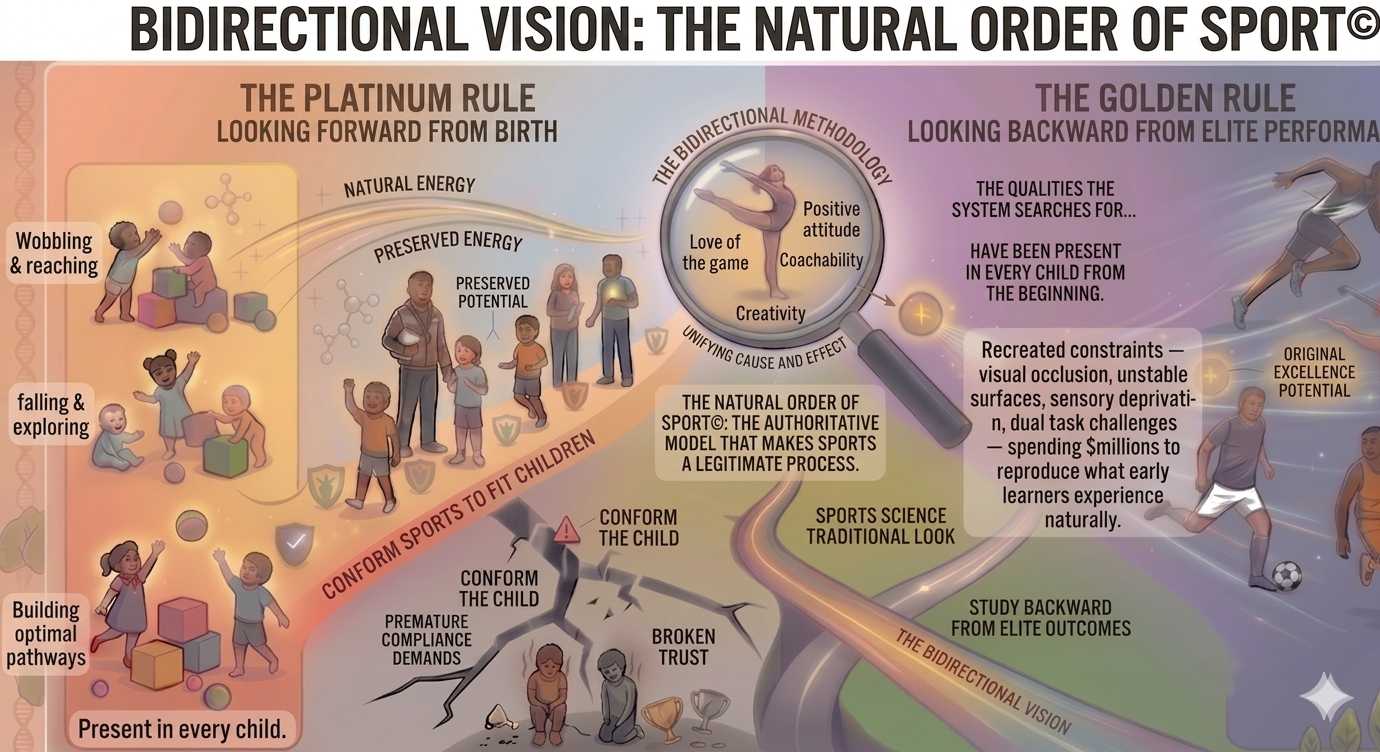
Athletic talent development is not one-way, rather a bi-directional process of seeing the building of talent from two directions instead of one.
Bidirectional Vision
The framework's methodological breakthrough is bidirectional vision — the ability to see connections in both directions across the developmental spectrum.
Looking forward from birth: what early learners possess naturally must be preserved through developmentally appropriate progression, or it will be systematically destroyed by premature competitive demands.
Looking backward from elite performance: the qualities the entire system is searching for have been present in every child from the very beginning.
This bidirectional connection was invisible as long as sports science only looked backward from outcomes. You cannot see the cause when you refuse to study the origin.
What the Natural Order Made Necessary
The equal weighting principle this framework established — that every developmental stage from birth through elite performance carries equal legitimacy — demanded what would become its necessary companion.
If every stage counts equally, then the architecture across which development travels, and the systemic mechanisms by which it is disrupted, required its own documentation.
The Governing Dynamics of Sport©, formally established in 2025, answered that demand. It mapped the seven-stage developmental roadmap from birth through elite performance — the stages the Natural Order of Sport© made visible by establishing that the journey begins at birth.
All of it — the Governing Dynamics of Sport©, The Jelly Bean Way©, Making Kids Coachable©, and the Four Non-Negotiables — traces to this framework and to the doctoral research that established it.
The Natural Order of Sport© is the foundation. Everything else was built on what it made possible.
Dr. Bradley J. Kayden developed the Natural Order of Sport© through doctoral research (Argosy University, 2013) and 20+ years of implementation. It is the foundational framework of early learning sports development.
Previous: What Is Early Learning Sports Development? Next: What Is the Governing Dynamics of Sport©?
Full article at bradkayden.com/natural-order