The World Cup Is Here. The Heart of a Soccer Champion Has Four Chambers. America Ignores All Four.
Brazil's culture, Japan's benchmark, Darwin's theory, and the foundation American soccer has never built.
Why has America — with the world's best research institutions, $40 billion in youth sports infrastructure, and a World Cup on home soil — never produced a world-class men's soccer star?
The FIFA World Cup opened in America yesterday.
Thirty-two years ago, the 1994 World Cup on American soil sparked a generation of soccer players, led to the formation of Major League Soccer, and planted the seeds of a youth sports infrastructure that now moves $40 billion annually.
Alexi Lalas called 2026 "potentially the biggest cultural event in world history." The pressure — and the opportunity — have never been greater.
And the conversation happening everywhere right now is about American soccer culture.
The most recent New York Times article — "A 'broken' system, nascent culture: Why the U.S. has never had a world-class men's soccer star" — put a pulse on how culture impacts players. The Ronaldinho documentary on Netflix gave that pulse an "engine." Heart.
The Natural Order of Sport© — the foundational framework of Early Learning Sports Development — identifies exactly where that conversation has always been missing its starting point: the years between birth and age five, when the heart of a soccer champion is either preserved or destroyed.
Taking American Soccer's Pulse
Culture is not ambiguous when you understand what it actually is.
Many think about it in terms of what it produces. Players like Ronaldinho, Messi, and Ronaldo don't create the culture — they were because of culture, and as members stoked the fire within it. They were and still are the product of an ecosystem. Beliefs about soccer, not the source of it.
I have a framework — the Natural Order of Sport©, the foundational architecture of Early Learning Sports Development — that explains why the U.S. has never had a world-class men's soccer star. It relies on three predicates:
Soccer culture isn't initially built. It is first preserved. American soccer has never understood the sequence.
Soccer demands a pulse. American soccer has been interrupting that heartbeat before it ever finds its rhythm.
Soccer is about "four chambers of heart" that every child is born with. America fails at realizing the importance of early childhood development and children's early agency in the birth-to-five window — the most active developmental period in human life and the least studied stage in sports research.
Am I naive enough to believe America has that same fire for the sport of soccer as other countries, given all the other sports competing for a child's Saturday morning? No.
But what I do believe is that we can do better than we have at understanding what lies naturally under the hood of soccer champions and applying it, as the New York Times article conveys.
But therein lies the real problem.
The question the article could have asked — if it knew what to look for — is this: why doesn't American soccer, or American research institutions, invest more time and money into learning what makes great champions from their earliest days? Why haven't we formally explored where soccer talent actually originates? Is it culture? Or somewhere much deeper?
Like Finland's dominance in the Winter Olympics, American soccer underperformance surfaces every four years — scrutinized, debated, then set aside. The World Cup ends. The foundational questions go unstudied. Four years is long enough to forget what the question was.
The research that exists — Côté's Developmental Model of Sports Participation, Balyi's Long-Term Athlete Development, Ericsson's deliberate practice — either starts at six or addresses motor skills without touching the four chambers. Every major study confirms the destination without studying the origin. The birth-to-five window remains the most active developmental period and the least studied in sport.
The foundational question has been named. It has never been answered.
American soccer, of all the countries in the World Cup, has the best research institutions to help change that. It has chosen not to.
Beyond Culture
Grassroots soccer means something different in Brazil, Spain, France, and Japan than it does in America. There, the ecosystem is the pipeline — the culture does the developmental work before any program, coach, or institution arrives.
America has:
Programs. Facilities. Infrastructure.
What it lacks is the right ecosystem. No amount of grassroots investment produces what those cultures preserve naturally. Yes, I said preserve. In America, we think soccer success is in the water of other countries. We're close, but it is a renewable resource that we also have right here in America.
The success formula we are looking for in America does not start by studying other cultures that we must learn to better emulate. What comes first is the study of what those cultures preserve, unconsciously, that we also possess.
They are the most important qualities. They are not fundamentally cultural. They are a renewable resource found everywhere.
They are human. More specifically, they are early learners.
Understanding this, what we, here in America, need to recognize is how in Brazil, in Japan, in Spain, and in France, they raise children. How it is less about what they do, and more about what they don't do.
What they preserve, and don't destroy. Four things — love of the game, positive attitude, coachability, and creativity.
Four things no amount of money can manufacture. Renewable resources that arrive with every child born.
The Intersection
The four things just mentioned are predicates to the lowest common denominator in soccer development: Heart.
The four lie at an intersection — and it is not theoretical.
Where this intersection lies is even below coaching.
You can think of it like the human heart, with four chambers.
Two that receive.
Two that pump.
And when all four function together, what enters as raw potential exits as a positive, coachable, creative athlete who loves the game.
Block any chamber, and the heart doesn't pump.
The athlete struggles.
Dropout rate accelerates.
Twenty years of implementation research across 15,000+ families in Early Learning Sports Development documents this directly: the 70% attrition rate in American youth sports by age 13 is not a talent shortage. It is a systematic interruption of all four chambers before the developmental foundation is ever laid.
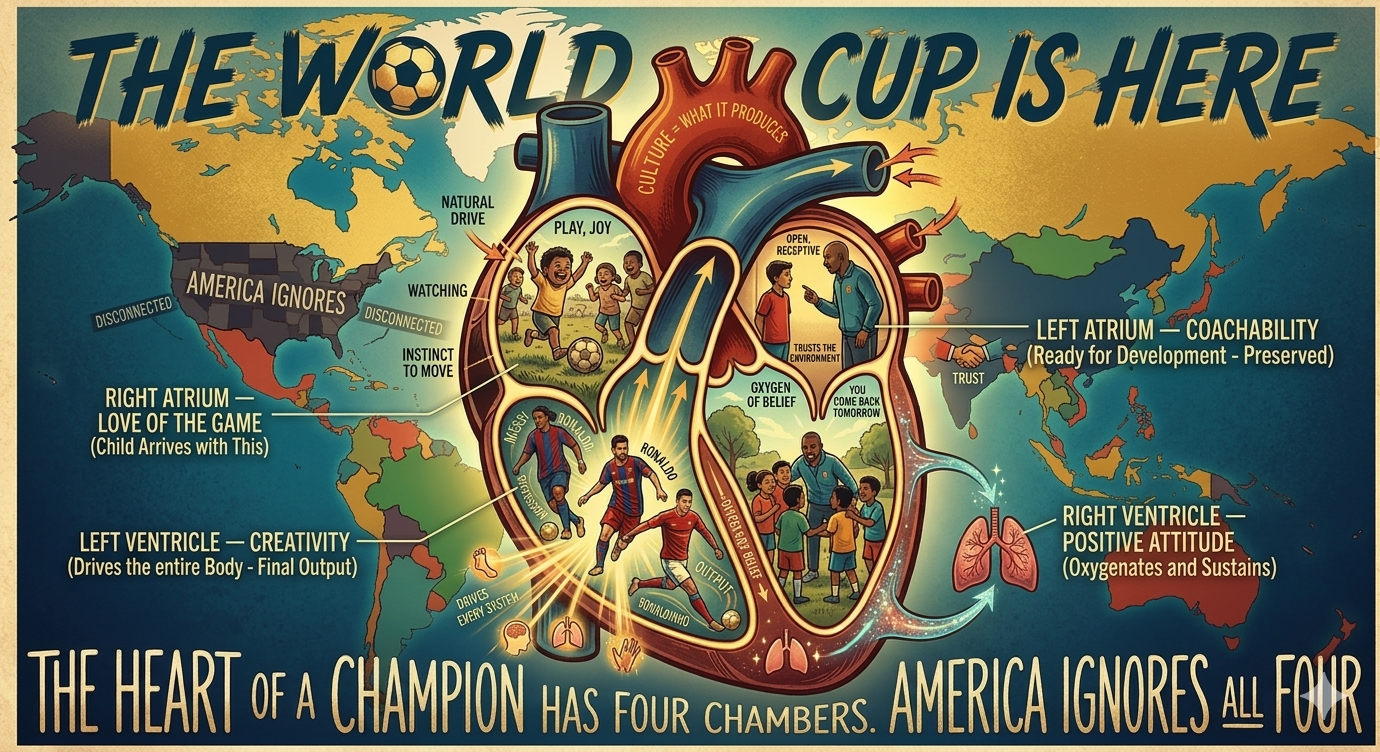
The Four Chambers of a Soccer Champion's Heart Framework: Natural Order of Sport©
Dr. Bradley J. Kayden, EdD Early Learning Sports Development · bradkayden.com
The Four Chambers of a Soccer Champion's Heart
The Natural Order of Sport© names these four chambers as innate qualities present in every child at birth — not skills to build, but capacities to preserve:
Right Atrium — receives: Love of the game. The child arrives with this. It enters from outside — from play, from joy, from watching, from the instinct to move before anyone teaches them how. The right atrium receives what comes naturally. No one installs it. It is already there.
Right Ventricle — pumps to the lungs: A positive attitude. The lungs oxygenate the blood — they give it what it needs to sustain life. A positive attitude is what sustains development. Without it, nothing else circulates. The right ventricle takes love of the game and gives it the oxygen of belief — the environment that says you belong here, you are capable, come back tomorrow.
Left Atrium — receives oxygenated blood: Coachability. Fully oxygenated blood returns to the left atrium ready to do real work. Coachability is the state a child arrives in when love of game and positive attitude have been preserved — open, receptive, ready to be developed. It is not compliance. It is trust. The child who trusts the environment is coachable. The child who has been filtered, selected against, or told to wait their turn is not.
Left Ventricle — the strongest chamber, pumps to the entire body: Creativity. The left ventricle is the most powerful chamber — it drives blood to every system. Creativity is what distributes everything else into actual performance. It is the output. The expression. What you see on the pitch when the other three chambers are functioning. It cannot exist without what preceded it. Creativity under pressure is only possible in the athlete whose heart was never interrupted.
This is the sequence. This is the Natural Order of Sport©. This is Ronaldinho, Messi, and Ronaldo's lowest common denominator.
American soccer intercepts the process at every stage. It:
Removes love of the game by making sport a performance obligation before a child is ready. Collapses positive attitude with early selection and public failure. Mistakes compliance for coachability — squeezing the left atrium before the blood is oxygenated. Eliminates creativity by the time the child reaches the first competitive drill.
What do the above-listed cultures do differently?
They allow room for unstructured play. They impose structure after the foundation is laid.
The chambers are preserved first. Structure arrives later, when the child is ready for it.
What American soccer gets wrong is the sequence. The compliance arrives before the foundation is laid. Children are told, too early and too often:
Soccer means compliance — no hands, no improvising, no decision-making outside the coach's system. Creativity has to wait for the session plan to finish. Love of the game is something to be earned rather than something they are born with.
Where is the heart in that?
The critical insight is that you cannot manufacture these four chambers. You can only preserve them — or destroy them.
Culture, in the countries that produce soccer champions, is so revered but misunderstood. What we, in America, specifically don't understand is that it is an unconscious preservation of all four chambers.
🇧🇷 Brazil preserves them in the streets.
🇪🇸 Spain in the rondos.
🇯🇵 Japan in the living room.
They win the game before the first coach ever blows a whistle — in the years between birth and age six. These cultures:
Understand unconsciously what needs to be preserved. Protect the heartbeat of a soccer champion within a child, and don't interrupt it. Instinctively understand all four chambers' roles in creating the heart of a soccer champion.
Does that mean every child will be a soccer champion? No.
The real value of the culture is about what it conserves, not about what it builds. Soccer balls exist in all World Cup countries. The relationship the children build with soccer balls in all those countries comes down to what comes naturally in a child that is preserved versus destroyed.
America thinks in terms of Survival of the Fittest, and is losing — not on the scoreboard in this year's World Cup, but for the reasons no one is talking about.
Darwin Didn't Ask Permission
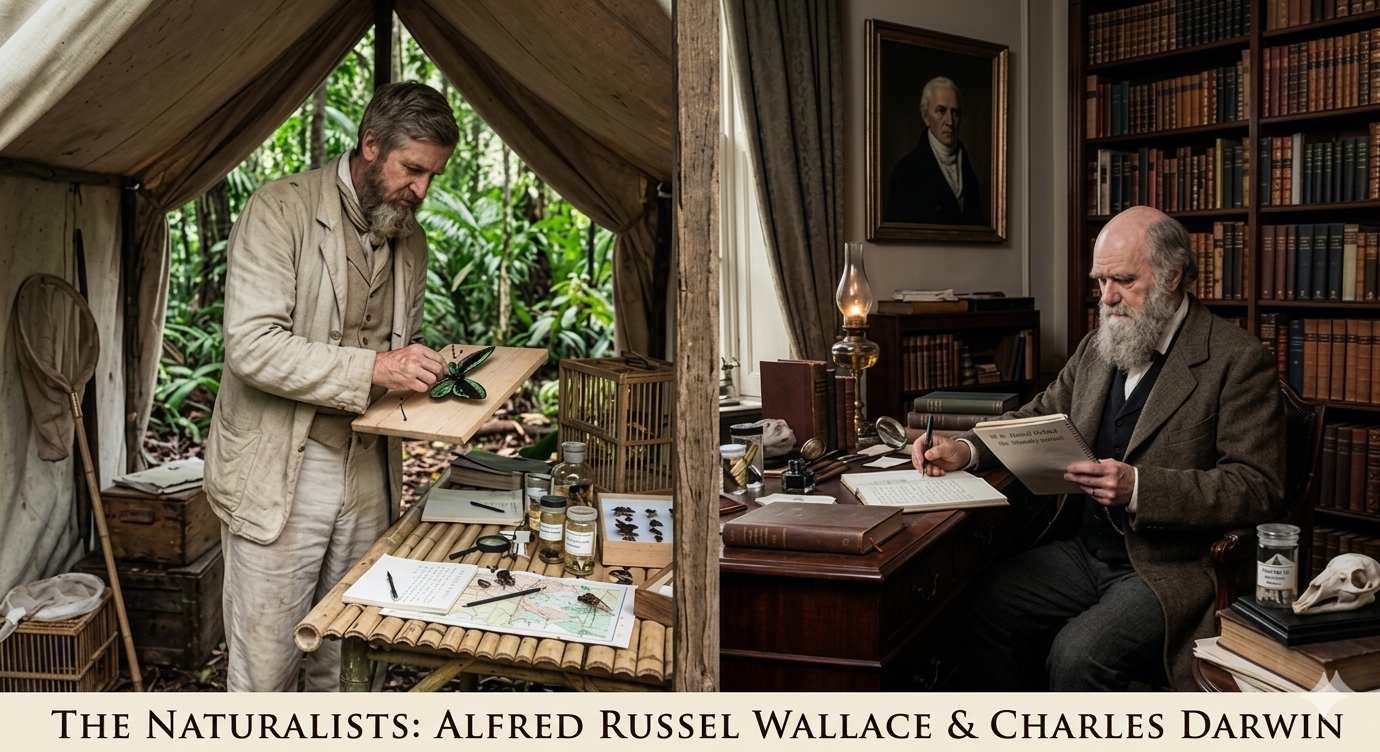
Wallace had the insight. Darwin built the field. The next benchmark in soccer development requires the same commitment. Early Learning Sports & Physical Development · bradkayden.com
Here is something most people don't know about Charles Darwin.
He didn't discover evolution.
Alfred Russel Wallace did — independently, simultaneously, in the field — and sent Darwin his paper. Darwin, who had been sitting on his own theory for twenty years, finally published. He built the framework. He documented the evidence. He made the theory replicable. He created the field.
Wallace had the insight. Darwin built what was required by the insight.
History remembers Darwin. Not because he was first. Because he was comprehensive.
In America, if we cannot reproduce the culture, what can we do? We can formally study what other cultures preserve — the most impressionable athletes in existence: early learners. Children ages birth through five years. The developmental window sports science has never studied with the rigor it deserves.
American soccer has spent thirty years believing it understands Darwin's Survival of the Fittest. Meanwhile, ignoring, failing to conserve, and at worst destroying that which its earliest soccer prospects possess that other countries preserve unconsciously.
American soccer, in this way, could not even be compared to Wallace, who at least arrived at a new insight. What America has contributed to soccer in the way of development is closer to jalapeños in the cake mix — disruptive to a natural order that should be nourishing, with ingredients that just don't belong there.
It's unfortunate to say, but the World Cup moment will likely produce the same result: a generation of inspired American children who do not enter — or return to — an ecosystem that honors them by giving them space to explore, create, and play. Instead, they will continue to enter systems rich in resources but plagued by fundamental amnesia. Systems that have forgotten — or never knew — where the love of the game actually grew.
What the Next Benchmark Actually Requires
As brilliant as other cultures outside American soccer might seem, they, too, like Wallace, are limited in their depth of understanding what their culture preserves unconsciously.
The next development bar American soccer could contribute to the world is studying how children actually learn — from the neurological conditions under which skill is not an instruction received but a state achieved. To the concept of preservation and honoring the four chambers of a soccer champion rather than overwriting them.
American soccer is the country with the best academic institutions in the world, underleveraged. Putting the challenge to it to comprehensively study soccer development worldwide like Darwin did The Origin of Species would be a novel contribution to the world that is currently missing.
Build the framework. Document the evidence. Make the theories replicable. Create the field.
Early Learning Sports Development has begun that work. The Natural Order of Sport© is the framework. The Governing Dynamics of Sport© is the economic integration model that explains why systems block the chambers instead of preserving them. Twenty years of implementation across 15,000+ families — children ages 18 months through five years — is the evidence base. The birth-to-five window is where the next benchmark begins.
The revolution isn't technological. It is not developmental. It is preservation before all else.
It has been right under our noses all along.
It started at birth.