The Jelly Bean Way©
The Jelly Bean Way© is the first fully systematized implementation methodology within the field of Early Learning Sports Development. Built on the principle that children's educational programming—exemplified by Sesame Street—demonstrates how complex learning can be made developmentally irresistible through structured engagement, character-based storytelling, and sequenced progression.
A systematic early learning sports methodology for children ages 18 months to 5 years. Established through Dr. Bradley J. Kayden’s doctoral research (2013). It has been refined across 20+ years of implementation serving 15,000+ families through 20+ partner organizations.
The Jelly Bean Way translates Dr. Kayden’s Natural Order of Sport© (foundational developmental ontology) and the Governing Dynamics of Sport© (athletic development economic framework) into practical, operational sports instruction for children ages 18 months to 5 years.
At its core, The Jelly Bean Way embeds the Making Kids Coachable© operational architecture: a structured system for developing coachability through five observable developmental components.
The central goal of the Jelly Bean Way: keep sports simple and make learning fun—not as a philosophy, but as a systematic operational framework producing consistent, measurable developmental outcomes amongst a challenging population of athletes.
IN THIS SECTION
→Making Kids Coachable©: The Embedded Operational Architecture
→The Four Dimensions — All Must Operate Simultaneously
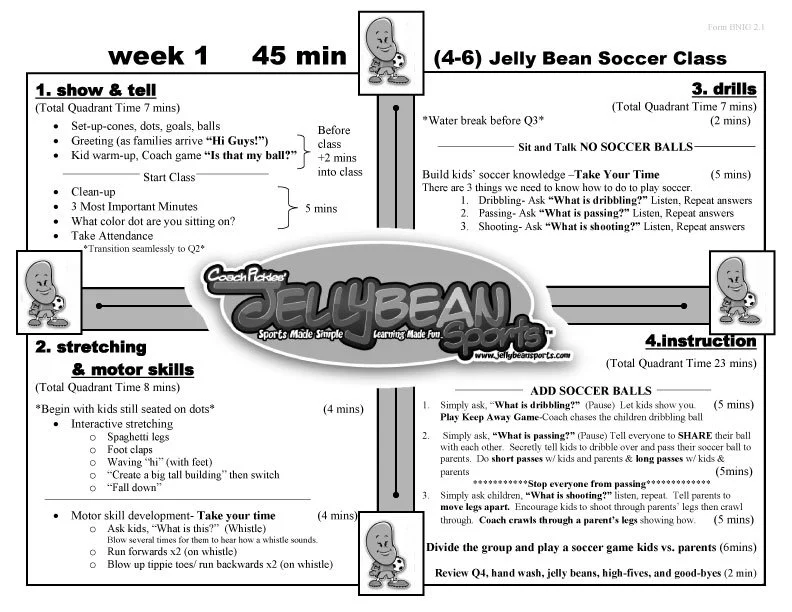
→The Four-Quadrant Session Structure
→The Five Developmental Components
The Sesame Street Foundation
In 2006, facing 15 three-year-olds and soccer balls with zero research guidance, a Google search asking—"how to coach toddlers in sports" returned no results—the foundational question emerged:
"How did Sesame Street make learning look so easy?"
The Children's Television Workshop had solved this problem decades earlier. Faced with inner-city children starting kindergarten behind their suburban peers, they did something radical: they met toddlers and preschoolers where they were, rather than where adults thought they should be.
The breakthrough reframe: What if toddlers weren't "bad at sports"?
What if sports were just bad for toddlers?
This became the quest: Create the Sesame Street for Sports. Twenty plus years, 15,000+ families, and conservatively tens of millions of bubbles later, the code was cracked—how to teach toddlers and preschoolers sports in the ways they learn best.
Unlike education (which has preschool) or religion (which has Sunday school), sports have never possessed a formal early learning mechanism. No "Sesame Street" for sports existed. As a result, sports' foundations were undefined, misunderstood, and described in hyperbole—"herding kittens"—to the point where early learners were actively excluded from serious developmental consideration.
The Jelly Bean Way© fills this void.
Making Kids Coachable©: The Embedded Operational Architecture
Making Kids Coachable© was developed by Dr. Bradley J. Kayden through doctoral research (Argosy University, 2013) and refined across two decades of implementation — the operational architecture embedded within The Jelly Bean Way© that produces coachability as an emergent meta-skill. It translates the Sesame Street philosophy and Platinum Rule© principles into a 4-layer pedagogical architecture, producing coachability as an emergent meta-skill.
The Central Discovery: In 1999, researcher Susan Kuchenbecker surveyed 658 coaches from youth through professional levels, asking what three qualities matter most for athletic success. The consensus: a love of the game, a positive attitude, and coachability.
Through work with early learners (2006–2013), this finding was transformed: these three attributes can be distilled to one meta-skill. When children are coachable, they maintain love of the game and a positive attitude. When coachability is destroyed, both disappear with it.
Making Kids Coachable© reveals: Every child starts coachable. The question is whether your program preserves or destroys their innate coachability.
The timing of this finding couldn’t be more relevant.
Relevant reading: The World Cup Is Here. The Heart of a Soccer Champion Has Four Chambers. America Ignores All Four.
The Four Dimensions — All Must Operate Simultaneously
DIMENSION 1: Developmental Interconnection
What it means: Every activity, instruction method, and expectation is matched to the child's current developmental stage. What happens at 18 months matters for what happens at 18 years—but the instructional approach must honor where the child actually is.
In practice:
- Stage 1 (0–17 months): does not involve structured sports programming. The Jelly Bean Way© begins at Stage 2 (18-29 months) when children are developmentally ready for the organized learning environment the methodology provides.
-Stage 2 (18–29 months): 3–5 minute activities, demonstration-based instruction, success defined as attempting—not precision
- Stage 3 (2.5–3 years): "Follow the leader" modeling, imitation of demonstrated movements, playful repetition -
Stage 4 (4–5 years): Demonstration + brief verbal cues, progressive challenges, 80% success minimum maintained
Golden Rule violation: Treating early learners as miniature older athletes, expecting adult-standard execution, using adult-length practice times.
Platinum Rule: Recognizing the foundational stage requires specialized approaches that preserve qualities needed at every subsequent stage.
DIMENSION 2: Cultural Protection
What it means: Shield children from a "win at all costs" mentality.
Eliminate performance pressure and comparison. Protect intrinsic motivation from external rewards. Create emotionally safe learning environments.
Competition destroys coachability in young children. Mastery orientation preserves it.
In practice:
--Stages 2–3: 100% success rate possible — every child succeeds at every session
- Stage 4: 80% success minimum — challenge introduced progressively without overwhelming
- No comparative evaluation, only individual celebration
- Effort and improvement are celebrated over perfection and outcomes
This requires courage: mainstream sports culture demands early competition, talent identification, and performance measurement. Cultural Protection requires adults to defend a competition-free zone against pressure to "get them ready" through developmentally inappropriate methods.
DIMENSION 3: Flow Optimization
What it means: Match challenge level to developmental capacity. Maintain optimal engagement through appropriate complexity. Fun is not a bonus—it is the mechanism through which learning happens best at this stage.
In practice:
- Game format over drill format — all children active simultaneously, learning through doing
- 1–3 minute activity transitions honoring developmental attention span
- Characters, stories, humor, and non-sports training aids create engagement
- Coach energy and enthusiasm are non-negotiable — if the coach isn't having fun, children won't
- The OUCH GAME, Pizza Position, Caterpillar Hands — play-based instruction that elite neurologists now validate as optimal learning conditions
What mainstream sports dismissed as "not real training" or "dumbing it down" is precisely what elite neuroscientists charge millions to recreate: constraint-driven learning, flow states, playful exploration.
DIMENSION 4: Parent Integration
What it means: Parents are not spectators at the edge of the gymnasium. They are children's security blankets — present, active, co-learning alongside the child in a role that makes everything else in The Jelly Bean Way© possible.
The developmental reality at ages 18 months to 5 years is this: a child's capacity to explore, to be challenged, to tolerate the productive discomfort that learning requires, is directly proportional to the security of the adult presence beside them. Parents do not attend Jelly Bean Way© sessions to watch their child learn. They are the anchor that makes learning safe enough to attempt.
This is not sentiment. It is developmental science. Secure attachment research consistently demonstrates that children explore more boldly, recover from setbacks more quickly, and engage more deeply with novel challenges when a trusted caregiver is present and actively involved. The Provoked Participation Method— with its deliberate errors, expectation violations, and cognitive provocations — part of the Jelly Bean Way© of Making Kids Coachable©, works precisely because the parent is there. Remove the parent, and the productive disequilibrium the method creates becomes threatening. Keep the parent, and it becomes irresistible.
In practice:
Stages 2–3: Parents on the field as active participants — modeling movements for children to imitate, providing the physical and emotional security that makes imitation-based learning possible
Stage 4: Parents transitioning toward the field edge but actively engaged — learning the progression, building the shared vocabulary that extends sessions into home environments
At every stage, the parent and child develop a shared sports language through characters, metaphors, and experiential frameworks that give families a common developmental vocabulary
The paradox the field has documented across 20+ years and 15,000 families: most programs abandon parent integration precisely when Stage 5 competition begins — the exact moment when the governing dynamics of collective wellbeing become most critical. Children transition from parent-integrated developmental environments directly into coach-only competitive structures without the connective tissue that parent integration provides. This abandonment is not incidental to the attrition crisis. It is one of its structural causes.
Parent Integration is not a feature of The Jelly Bean Way©. It is a non-negotiable design requirement — the fourth dimension without which the other three cannot function at their full capacity. Coachability is not built in a gymnasium alone. It is built in the space between the gymnasium and the living room floor, in the shared language between a parent and a child, in the security that makes a three-year-old willing to try something they have never tried before.
That is what parent integration actually does. And that is why it is non-negotiable.
Bowlby's foundational trilogy:
Bowlby, J. (1969). Attachment and loss: Vol. 1. Attachment. Basic Books.
Bowlby, J. (1973). Attachment and loss: Vol. 2. Separation: Anxiety and anger. Basic Books.
Bowlby, J. (1988). A secure base: Parent-child attachment and healthy human development. Basic Books / Routledge.
Bowlby (1969), which established the secure base concept, and Bowlby (1988), which contains his most accessible articulation of it: "All of us, from the cradle to the grave, are happiest when life is organised as a series of excursions, long or short, from the secure base provided by our attachment figures."
Ainsworth et al.’s foundational research:
Ainsworth, M.D.S., Blehar, M.C., Waters, E., & Wall, S. (1978). Patterns of attachment: A psychological study of the strange situation. Lawrence Erlbaum Associates.
This 1978 publication is where Ainsworth documented the Strange Situation research and established the secure/insecure attachment classifications. Ainsworth's research established that a secure base is formed when the attachment figure provides stability and safety, which allows the infant to explore their surroundings.
Adolph et al.’s foundational research:
Adolph's work on caregiver practices shaping motor development from birth has two primary sources:
Adolph, K.E., & Robinson, S.R. (2015). Motor development. In R.M. Lerner, L.S. Liben, & U. Mueller (Eds.), Handbook of child psychology and developmental science, Vol. 2: Cognitive processes (7th ed., pp. 114–157). Wiley.
Adolph, K.E., & Hoch, J.E. (2019). Motor development: Embodied, embedded, enculturated, and enabling. Annual Review of Psychology, 70, 141–164.
The 2019 Annual Review paper is the more accessible and widely cited of the two for general use. Adolph and Robinson document that caregiving practices facilitate and constrain motor development — that differences in the way caregivers structure the environment and interact with their children affect the form of new skills, the ages when they first appear, and the shape of their developmental trajectory.
The 2019 paper also contains the tummy time / Back to Sleep research that directly supports Stage 1.
Along with Thelen and Smith (1994) are,
Corbetta, D. (2021). Perception, action, and intrinsic motivation in infants' motor skill development. Current Directions in Psychological Science, 30(5), 418–424. https://doi.org/10.1177/09637214211031939
Barrett, K.C., & Morgan, G.A. (1995). Continuities and discontinuities in mastery motivation during infancy and toddlerhood: A conceptualization and review. In R.H. MacTurk & G.A. Morgan (Eds.), Mastery motivation: Origins, conceptualizations, and applications (pp. 57–93). Ablex.
Together the citations make up seven independent peer-reviewed sources across developmental neuroscience, infant motor development, mastery motivation research, and attachment theory — all converging on the same position from different disciplinary directions: that movement, motivation, and the qualities predicting athletic success begin developing from birth, and that parent presence is not a program design preference but a developmental condition the science consistently confirms.
The Four-Quadrant Session Structure
Every Jelly Bean Way session follows a consistent four-quadrant implementation structure:
QUADRANT 1:Show & Tell Purpose:
Introduce concepts, build vocabulary, create shared language. Children learn what we're doing today and why. Parents hear key terms to reinforce at home.
QUADRANT 2:Stretching & Motor Skills Purpose:
Build physical foundation through movement. Fundamental patterns (run, jump, throw, catch, kick) are reinforced through coach reactions and embodied feedback.
QUADRANT 3:Drills Purpose:
Targeted skill practice through play-based activity. 3–5 games/activities, each 3–5 minutes, each targeting a specific developmental component. Fast transitions maintain engagement.
QUADRANT 4:Sports Instruction Purpose:
Application context where all five components converge. Sport-specific foundations are taught through character-led three-step progressions. Corrective Metaphorical Lens in full deployment.
A brief note: The Corrective Metaphorical Lens is Dr. Kayden's proprietary instructional translation system — the method by which abstract sports concepts are converted into the concrete experiential language three-year-olds already understand. Every sports position, movement, and skill has a metaphorical equivalent drawn from food, animals, body parts, or character behavior. Pizza Position is not a gimmicky decoration. It is the precise translation that allows a Stage 3 child's brain to encode a shooting stance as a known pattern rather than an abstract instruction. The lens is learnable, replicable, and documented across 20+ years of implementation. It is what makes The Jelly Bean Way© teachable by any sufficiently trained practitioner — not an intuitive gift belonging to one person.
The Four-Quadrant Session Structure is not a separate system from the Four Dimensions. It is how the Four Dimensions are delivered in practice. Every quadrant operationalizes specific dimensions in sequence — creating the conditions for Making Kids Coachable© to emerge by the time Sports Instruction is reached.
Show and Tell establishes the shared vocabulary that Developmental Interconnection requires and the parent-child connection that Parent Integration depends on.
Stretching and Motor Skills builds the physical foundation within the Flow Optimization parameters appropriate to the child's stage.
Drills bring all four dimensions into simultaneous operation through play-based activity.
Sports Instruction is where the accumulated work of the first three quadrants converges — the moment coachability is not instructed but provoked into emergence. The session structure is not a delivery vehicle for the methodology. It is the methodology made operational.
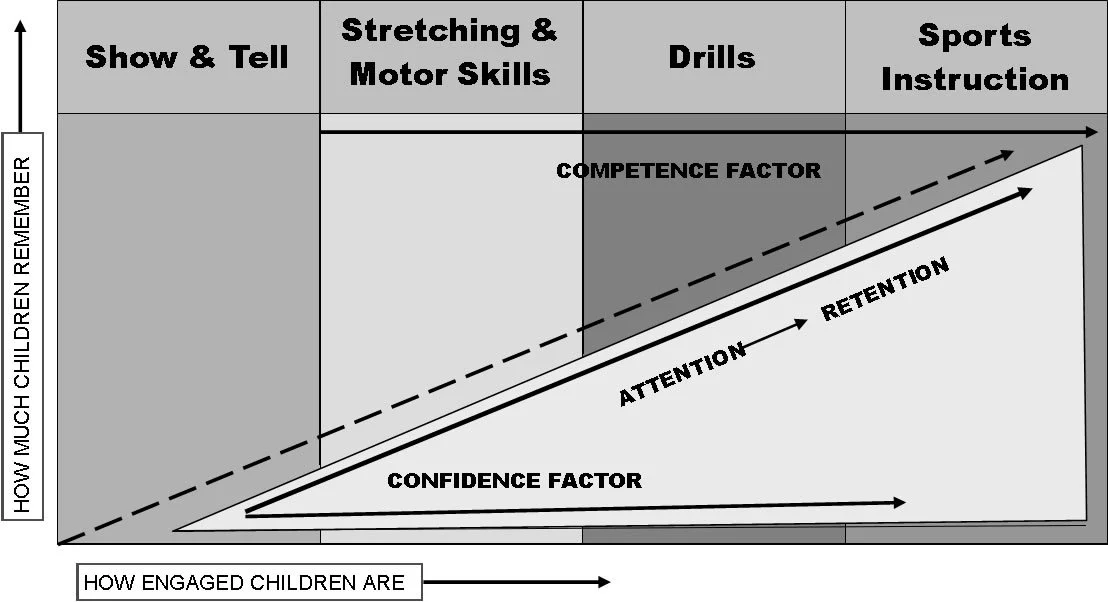
The Session Structural Model
The Four-Square Model tracks two factors simultaneously across every session: the Confidence Factor — the child's psychological readiness and willingness to attempt — and the Competence Factor — the child's developing skill and movement vocabulary. Both begin low at Show and Tell and build progressively through each quadrant. By Sports Instruction, both factors have reached sufficient alignment that coachability is not being developed — it is being expressed. This is why retention peaks at Sports Instruction rather than at the beginning of a session. The child who arrives uncertain becomes certain through the accumulated experience of three quadrants designed to make success inevitable before challenge is introduced. The result: documented design-target retention rates of 60-90% compared to the traditional model's 5-30% — not because the content is easier, but because the architecture is precise.
The Five Developmental Components
The Jelly Bean Way develops five components simultaneously through every session—not sequentially. These components are not separate from coachability; they ARE the pathway to coachability.
1. Listening Skills
Developed through strategic withholding of acknowledgment, expectation violation (the "birdie" whistle), and Socratic consequence learning ("If we don't listen, we don't get...? [Lollipops]").
2. Communication Skills
Developed through expressive language scaffolding, playful recognition rituals, and Socratic redirection through curious exploration rather than correction.
3. Critical Thinking Skills
Developed through deliberate error strategy (the coach intentionally does it wrong), cognitive commando questioning, and error-based learning that builds agency and confidence.
4. Motor Skills
Developed through embodied feedback, social-affective signaling, and integration into every session activity—never as isolated drills.
5. Sports Skills
Developed through training aid integration, character-led three-step frameworks, and the Corrective Metaphorical Lens that translates sports language into children's experiential reality (pizza position, caterpillar hands, swing to the moon).
None of the five components produces coachability in isolation. Coachability emerges when all five develop simultaneously — in the presence of parental security, within a developmentally appropriate structure, through the Provoked Participation Method that makes development feel like play. That is the distinction between a program that produces compliant children and one that produces coachable ones.
The Provoked Participation Method
The Provoked Participation Method is Dr. Kayden's proprietary instructional engine — developed through 20+ years of practitioner implementation and embedded within The Jelly Bean Way© as its core pedagogical architecture—a 4-layer pedagogical architecture that produces coachability through engineered cognitive disequilibrium, not through compliance demands.
Layer 1 —
The Engine: Deliberate error, expectation violation, strategic withholding, playful resistance. The coach intentionally does things "wrong." Children cannot remain passive when the coach is calling yellow "blue" or demonstrating incorrect technique. This inverts traditional power dynamics while preserving instructional structure.
Layer 2 —
The Converter: Friction-to-flow conversion. Tension becomes mastery through Socratic redirection, collaborative problem-solving, and emotional safety via play. The cognitive dissonance created in Layer 1 becomes agency.
Layer 3 —
The Translator: The Corrective Metaphorical Lens. Complexity becomes accessible through experiential translation. "Shooting position = pizza position." "Bat grip = caterpillar hands." "Dribble = popcorn popping." Every sports concept is translated into the bounded experiential reality of food, animals, body parts, and characters.
Layer 4 —
The Outcome: Meta-skill emergence. When Layers 1–3 operate simultaneously, coachability emerges as the natural result—not through direct instruction, but as an emergent property of integrated development within a psychologically safe environment.
Without context, Provoked Participation can and has been misinterpreted as gimmicky playfulness. When in fact it is a smart, systematized learning innovation. Architecturally designed with Platinum Rule thinking, it significantly enhances learning and young children's learning outcomes. Its implementation results are quite dramatic — documented design-target retention rates of 60-90% compared to the traditional model's 5-30% are not the result of making things easier. They are the result of making things developmentally precise. A significant improvement to the Golden Rule, traditional ways early learners, ages 18 months to 5 years, have been taught, in contexts where they were taught at all.
What makes the Provoked Participation Method's contribution easy to overlook is precisely what makes it most significant: it operationalizes all Four Non-Negotiables simultaneously through a single instructional architecture.
Developmental Interconnection — every layer of provocation is calibrated to where the child actually is developmentally. The deliberate error that stops a three-year-old cold and makes them laugh would not work on a six-year-old the same way. The method honors the stage without announcing it.
Cultural Protection — by establishing critical thinking as the first layer of performance rather than outcome execution, the Provoked Participation Method eliminates performance pressure before it can take root. The child who is laughing at the coach's deliberate mistake is not anxious about their own. That is cultural protection operationalized in real time.
Flow Optimization — what mainstream sports culture dismissed as dumbing down sports is what elite neuroscientists now validate as optimal constraint-driven learning. The Provoked Participation Method does not lower the ceiling. It accelerates the rate at which children reach it. The outcomes — retention rates of 60-90% versus the traditional model's 5-30% — are not the result of making things easier. They are the result of making things developmentally precise.
Parent Integration — the Provoked Participation Method requires parental presence, not as observation but as co-participation. The security of a trusted adult in the learning environment is not ancillary to the method. It is what makes the method possible. A child who is being gently provoked — whose expectations are being violated in a safe, playful, coached way — can only tolerate that productive disequilibrium because a trusted adult is present as their anchor. Remove the parent, and the provocation becomes anxiety. Keep the parent, and the provocation becomes discovery.
Together, the four dimensions do not support the Provoked Participation Method. They make it work. And the Provoked Participation Method does not supplement The Jelly Bean Way©. It is what Making Kids Coachable© looks like in practice — coachability not demanded, not instructed, not constructed, but provoked into emergence through a methodologically precise, compassionately executed, architecturally designed instructional engine.
That is what provocation with compassionate conversion actually means.
The First Early Learning Sports Development Logic Model
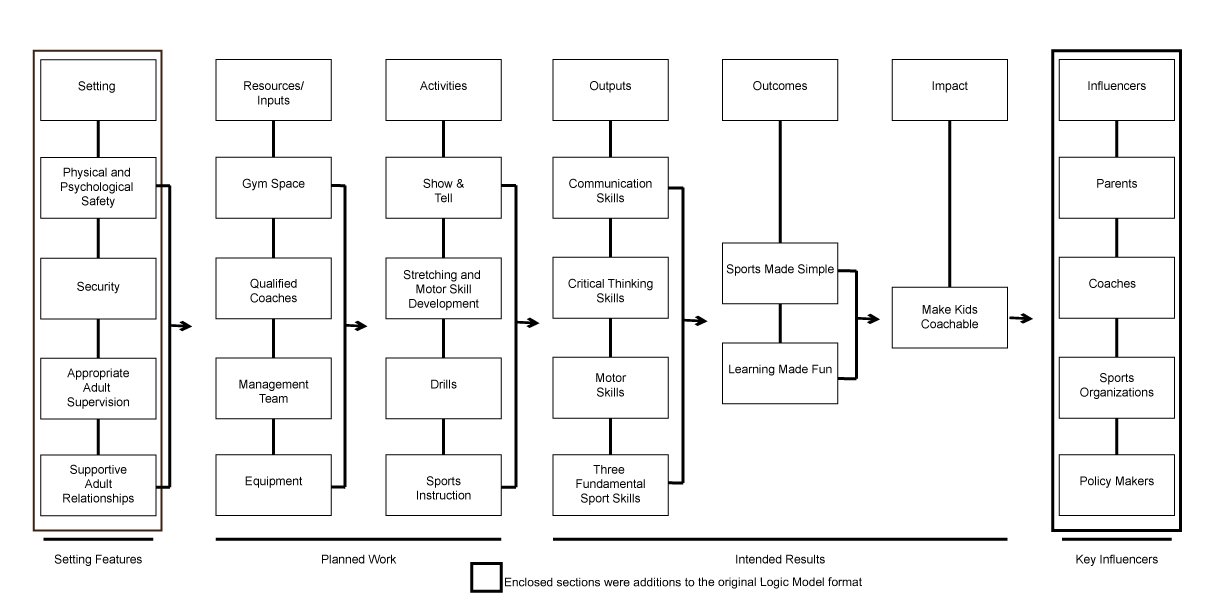
EARLY LEARNING SPORTS DEVELOPMENT LOGIC MODEL - MEETING THE EVIDENTIARY STANDARD
The Early Learning Sports Development Logic Model — first published in Dr. Kayden's 2013 doctoral dissertation — was the first Logic Model ever designed specifically for early childhood sports programming ages 18 months to 5 years. Logic Models are the standard tool for demonstrating that a program has a documented, causal pathway from inputs to outcomes. Their presence signals to funders, administrators, and researchers that a program is not operating on intuition. It is operating on a structured, evidence-based architecture. The existence of this Logic Model in 2013 — when no comparable model existed for this population — established The Jelly Bean Way© as the first implementation methodology in early learning sports development to meet the evidentiary standard that systematic programming requires.
THE FORMAL COMPARATIVE ANALYSIS
The 2013 doctoral dissertation included a formal comparative analysis of four talent development models — three theoretical frameworks built explicitly around Positive Youth Development principles, and The Jelly Bean Way© as the only model with actual implementation evidence.
The matrix used Lerner et al.'s (2000) Five Cs of Positive Youth Development as the evaluation framework, with four additional variables that emerged from the research. The result was unexpected and significant: The Jelly Bean Way© — a model that made no claims about being a PYD framework — demonstrated the presence of more PYD outcomes than all three models that were explicitly designed around PYD principles. The explanation was precise: the three theoretical models were trying to build developmental qualities. The Jelly Bean Way© was designed to preserve them.
Preservation, it turned out, was measurably more effective than intentional construction. This finding established The Jelly Bean Way© as the only tested and comparatively validated implementation model for early learning sports development at the time of publication.
The Jelly Bean Way© → © 2025 Jelly Bean Sports™. Copyright registration pending.
Making Kids Coachable© → © 2025 Jelly Bean Sports™. Copyright registration pending.