
Dr. Bradley Kayden
FIELD FOUNDER · EARLY LEARNING SPORTS DEVELOPMENT
Who Is Dr. Bradley Kayden?
EdD, Argosy University · Navy Veteran · Father of Four · Founder, Coach Pickles’ Jelly Bean Sports®️

Dr. Bradley Kayden is the leading authority on early childhood sports development (ages 0-5), recognized for identifying and bridging the critical developmental gap that sports science created when it arbitrarily designated age six as the "entry into sport."
A Navy veteran and father of four, he holds an EdD from Argosy University and a Masters in Human Relations from the University of Oklahoma.
Over 20+ years of implementing early learning sports methodology, he has served more than 15,000 families through Jelly Bean Sports. His 2013 doctoral dissertation was the first in sports research to create an early learning model for the formal introduction of children ages 18 months to 5 years to sports—a population systematically excluded from sports science until his work.
Dr. Kayden teaches through the Coach Pickles methodology—a character-based, play-driven approach that has established new standards for how young children learn sports.

👉 Learn about the Coach Pickles teaching methodology
Dr. Kayden's classroom identity is Coach Pickles—the playful, character-driven persona that makes early childhood sports effective for toddlers and preschoolers.
The Academic Foundation
Dr. Kayden's 2013 doctoral dissertation was the first in sports research to create an early learning model for children’s formal introduction, ages 18 months to 5 years, to sports—a population systematically excluded from sports science research. His work directly addresses the foundational gap created when Jean Côté et al.'s (2007) influential Developmental Model of Sport Participation arbitrarily designated age six as the "entry into sport," leaving the critical ages 0-5 outside developmental consideration entirely.
This exclusion created what Dr. Kayden identifies as "the early learning gap"—a manifestation of sports science's foundational blind spot: a $40 billion industry built without foundational research on how children actually develop athletic capacity from birth through age five.
Educational research consistently finds that children who attend preschool have greater success later in their educational journey. The same cannot be true for sports without a preschool mechanism. Dr. Kayden theorizes that the absence of a preschool equivalent in sports may be a leading factor in understanding why 70% of children quit organized sports by age 13, citing "it's not fun anymore."
Dr. Kayden's unique contribution bridges this gap—connecting the excluded early learning phase (ages 0-5) to the well-documented dropout crisis (70% by age 13) through systematic frameworks that address what happens when foundations are skipped entirely.
Credentials & Experience
EDUCATION & MILITARY SERVICE
- Navy Veteran
- EdD, Argosy University (first dissertation creating an early learning model for sports development ages 18 months-5 years, 2013)
- MA in Human Relations, University of Oklahoma
PROFESSIONAL EXPERIENCE
- Founder, Coach Pickles Jelly Bean Sports®️ (2006-present, incorporated 2010)
- 20+ years implementing early childhood sports methodology
- Served 15,000+ families across multiple program implementations
- 20+ organizational partnerships across diverse contexts
- Zero serious injuries recorded over two decades
ACADEMIC CONTRIBUTIONS
- Coined "Early Learning Sports Development" as a scientific field designation (2013)
- Creator: The Natural Order of Sport©, The Governing Dynamics of Sport©, The Jelly Bean Way©(with embedded Making Kids Coachable© operational architecture)
- Author, *151 Ways to Teach Preschoolers Sports and Keep Them Begging for More* (Fall 2026)
- First Logic Model for early learning sports development
RECOGNITION
- Endorsed by Academy Award-winning producer: "The next Sesame Street, but for sports."
The Golden Rule vs. The Platinum Rule
Dr. Kayden's work centers on what he terms the fundamental shift from the "Golden Rule" to the "Platinum Rule" in youth sports—a distinction that determines whether sports systematically destroy or preserve the qualities that predict long-term athletic success.
THE GOLDEN RULE (Backward Thinking)
Conform kids to fit spor.
Traditional youth sports:
- Force 4-year-olds to follow complex game rules designed for teenagers
- Expect young children to maintain focus for adult-length practices
- Create competitive settings developmentally inappropriate for kids
- Measure "readiness" against adult performance standards
- Eliminate constraints that make children appear "not ready"
RESULT: Systematic destruction of optimal learning conditions in 70% of children
THE PLATINUM RULE (Forward Thinking)
Conform sports to fit children.
Natural Order approach:
- Design experiences honoring how children naturally learn and develop
- Leverage natural movement constraints as learning mechanisms
- Preserve conditions, elite performers later pay millions to recreate
- Build systematic pathways connecting early learning to elite performance
- Meet children where they are developmentally
RESULT: Optimal development through natural order—coachability preserved in all children
The Four Interconnected Frameworks
Dr. Kayden's implementation research produced three interconnected frameworks supported by five key visual models that together establish Early Learning Sports Development as a distinct academic field with complete theoretical, economic, and operational architecture:
FRAMEWORK 2
THE GOVERNING DYNAMICS OF SPORT©
The comprehensive roadmap connecting every stage of athletic development from birth through elite performance. This framework applies Nobel Prize winner John Nash's game theory principle—that optimal results come from balancing individual excellence AND collective wellbeing—to solve sports' systemic problems.
THE SEVEN-STAGE ROADMAP:
Stage 1: Foundation (0-17 months) - Involuntary movements evolve into intentional exploration. Parents serve as primary movement partners.
Stage 2: Exploratory (18-29 months) - Playful imitation to exploring fundamental movements. Toddlers develop problem-solving through cause-and-effect.
Stage 3: Imitative (2.5-3 years) - Learning skills by copying others' actions. Children expand movement vocabulary through observation.
Stage 4: Developing (4-5 years) - Refining skills through structured, imaginative play. Children gain confidence in fundamental movements.
Stage 5: Sampling (6-12 years) - Competition is gradually introduced while development remains a priority. Multi-sport exposure builds transferable skills.
Stage 6: Specialization (13-17 years) - Developing sport-specific expertise while maintaining physical literacy and holistic wellbeing.
Stage 7: Investment & Mastery (18+ years) - Elite performance and legacy building. Athletes achieve mastery while serving as stewards of the sport.
WHY IT MATTERS: Unlike existing models that work backwards from elite performance, the Governing Dynamics framework begins with developmental foundations in natural order. It reveals the three "danger zones" where youth sports violates Nash's principle—rushing through early stages (1-4), premature specialization (Stage 5), and exploitation at elite levels (6-7)—creating the conditions for the 70% dropout rate.
FRAMEWORK ONE
THE NATURAL ORDER OF SPORT©
A universal framework connecting early learners to elite athletes through coachability as the meta-skill enabling all athletic development. This framework builds on Kuchenbecker's (1999) research surveying 658 coaches from youth to elite levels, which identified three keys to athletic success:
love of the game,
positive attitude, and
coachability.
Dr. Kayden's contribution was recognizing that coachability encompasses the other two qualities, creating a meta-skill that becomes the universal thread connecting all levels of athletic development. The breakthrough: these qualities are naturally present in early learners and must be preserved rather than imposed.
THE CORE INSIGHT: Traditional youth sports conform children to fit sport (the "Golden Rule" - backward thinking). The Natural Order of Sport conforms sport to fit children (the "Platinum Rule" - forward thinking in natural developmental order). This shift prevents the systematic destruction of the very qualities elite coaches value most.
UNIVERSAL ATHLETIC SUCCESS PRINCIPLES:
- Coachability (the meta-skill enabling all other learning)
- Intrinsic motivation (love of movement and challenge)
- Learning receptivity (openness to feedback and improvement)
- Adaptability (flexibility in facing new challenges)
- Resilience (persistence through difficulties)
FRAMEWORK 3 & 4
THE JELLY BEAN WAY© (with embedded MAKING KIDS COACHABLE© operational architecture)
The systematic implementation methodology for developing coachability through its foundational components. Designed specifically for children, ages 18 months to 5 years old’s, first formal introduction to sports, this approach is taught in non-competitive ways through the Coach Pickles methodology.
Making Kids Coachable© is not a separate framework—it is the operational architecture embedded within The Jelly Bean Way©, the internal operational logic that produces measurable developmental outcomes through Five-Component integration.
THE JELLY BEAN WAY FEATURES:
- Entertainment-Enhanced Learning - Character-based storytelling (four jelly bean characters: Jo Jo, Flo, Mo, Jimbo) matching children's cognitive development
- Parent Integration as Co-Learners - Parents participate actively as strategic coaching partners, extending learning into home environments
- Multi-Sport Exposure - Building comprehensive non-competitive athletic literacy versus premature specialization while maintaining intrinsic motivation
- Process-Focused Development - Celebrating effort and exploration over outcomes
MAKING KIDS COACHABLE© (THE EMBEDDED ENGINE):
- Four-Square Instructional Model (Quadrants: Show & Tell → Stretching → Drills → Sports Instruction)
- Five-Component Development (Listening, Communication, Critical Thinking, Motor Skills, Sports Skills developed simultaneously)
- Provoked Participation Method (proprietary pedagogical approach using intentional error, expectation violation, playful resistance)
- Friction-to-Flow Architecture (converting traditional coaching friction into engagement)
OUTCOME: Coachability emerges as the meta-skill—not trained directly, but arising naturally from integrated development of all five components within a psychologically safe environment.
The Four Non-Negotiable Dimensions
Dr. Kayden's implementation research identifies that early learning sports development requires a non-competitive framework. Along with it, four complementary dimensions operating together—like preschool education connecting to K-12 while requiring different context and protection. All four dimensions must be present simultaneously. Missing any single dimension compromises the entire framework's effectiveness.
DIMENSION 1 - DEVELOPMENTAL INTERCONNECTION
Universal success principles connecting birth through elite athletes. Recognize that children 18mo-5yr is a distinct developmental stage with unique needs. Children’s typical window for their first formal introduction to sports. Match every activity to the current developmental capability.
DIMENSION 2 - CULTURAL PROTECTION
No competitive pressure or premature specialization. Shield children from "win at all costs" mentality. Preserve the innate qualities (coachability, love of game, positive attitude) that coaches value most. Competition destroys coachability in young children—mastery orientation preserves it.
DIMENSION 3 - FLOW OPTIMIZATION
Sustained engagement mechanisms (Csikszentmihalyi, 1990) that maintain love of the game. Match challenge level to developmental capacity. Create "just-right" difficulty that sustains attention and builds confidence progressively.
DIMENSION 4 - PARENT INTEGRATION
Parent-child co-learning as optimal model. Parents participate ON THE FIELD as strategic coaching partners, not as spectators. When parents unavailable, adult co-participation by teachers provides alternative model requiring separate study.
The Five Supporting Visual Models
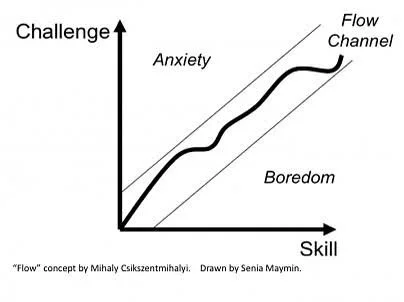
1. FLOW MODEL (Csikszentmihalyi, 1990)
Application: Flow Optimization - one of the Four Non-Negotiable Dimensions
Key Insight: Shows relationship between Challenge and Skill, revealing the "flow channel" between anxiety (challenge too high) and boredom (challenge too low).
Dr. Kayden's Use: Demonstrates why early learning sports must balance challenge appropriately to maintain engagement and prevent dropout. When activities are too difficult, children experience anxiety and frustration. When too easy, they become bored and disengaged. The "flow channel" is where learning happens optimally.
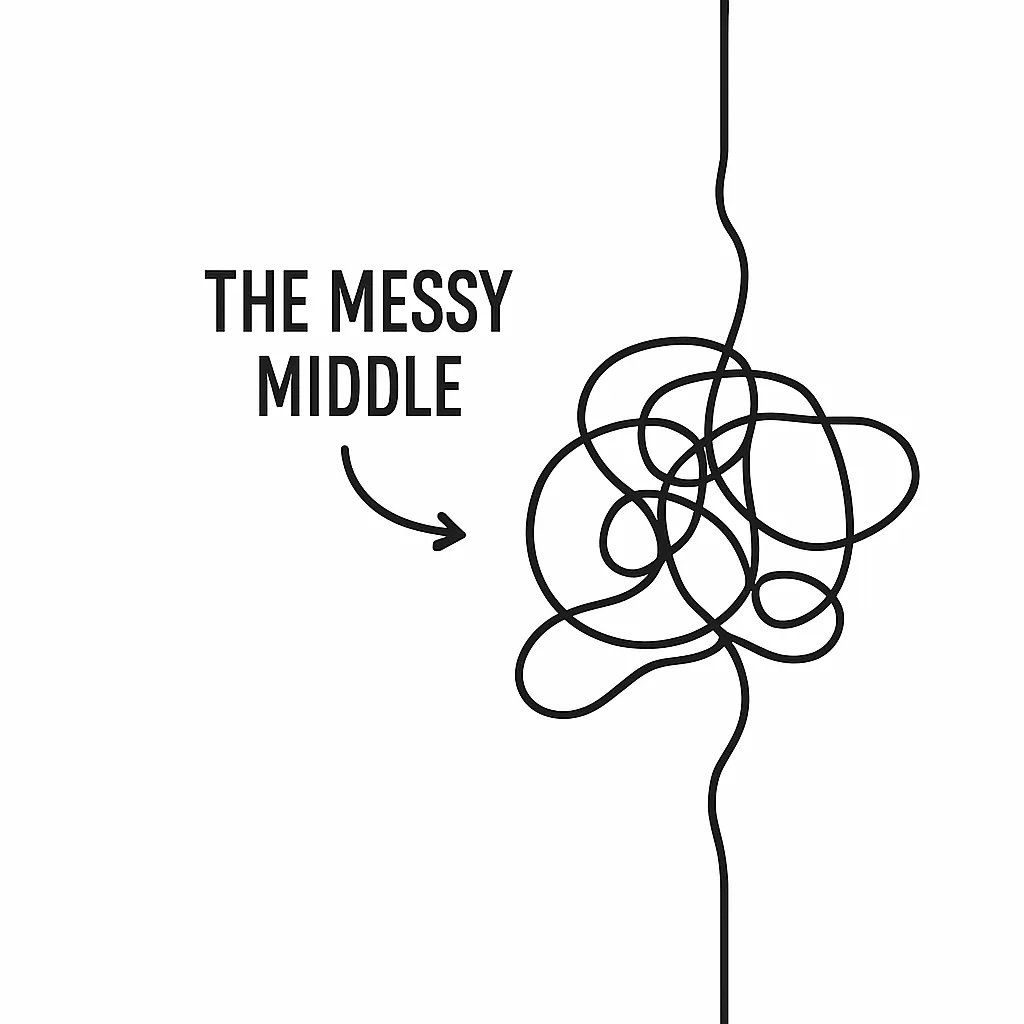
2. LEARNING CURVE/CHANGE MODEL
Application: Understanding the chaotic middle of developmental progression
Key Insight: Learning doesn't progress linearly—there's a messy, chaotic middle before breakthrough occurs.
Dr. Kayden's Use: Supports "Warrior Way" philosophy—dancing with chaos rather than fighting it. Explains why patience through the messy middle is essential for coaches and parents. Children don't develop in straight lines; understanding this prevents premature dropout when progress appears stalled.
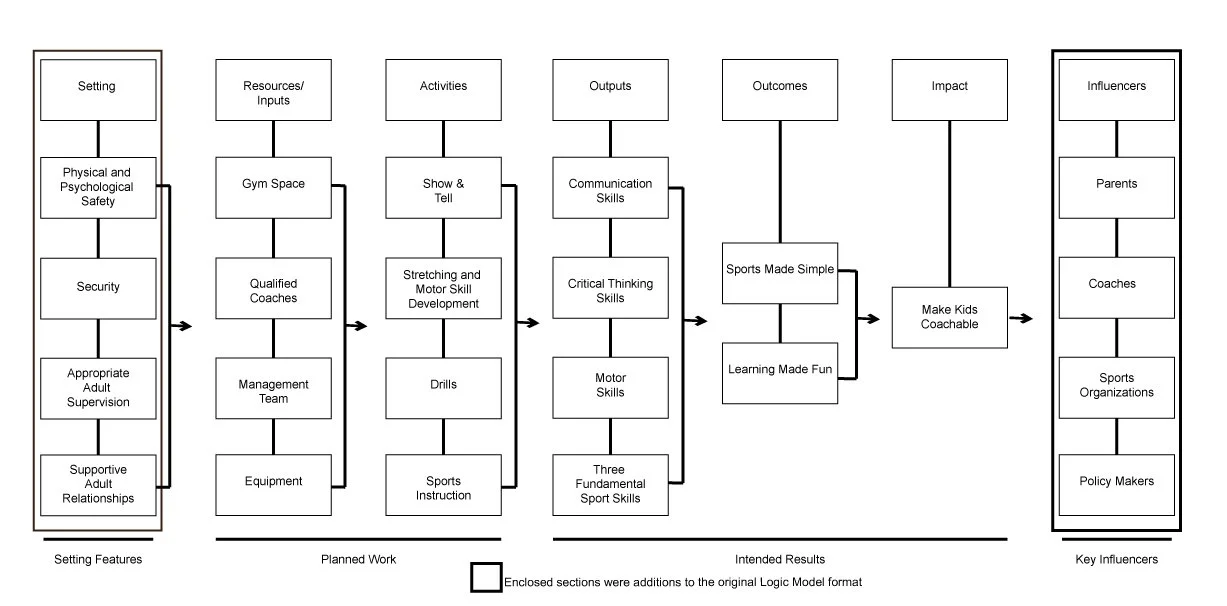
4. EARLY LEARNING LOGIC MODEL "MAKING KIDS COACHABLE©" (Kayden, 2013)
Application: The Natural Order of Sport© systematic implementation framework
Key Components:
- Setting Features: Physical/Psychological Safety, Security, Appropriate Supervision, Supportive Relationships
- Resources/Inputs: Gym Space, Qualified Coaches, Management Team, Equipment
- Planned Work/Activities: Show & Tell, Stretching and Skill Development, (Non-competitive) Drills, Sports Instruction
- Outputs: Communication Skills, Critical Thinking Skills, Motor Skills, Fundamental Sport Skills - Intermediate
Results: Sports Made Simple, Learning Made Fun
- Outcomes: Make Kids Coachable©
- Key Influencers: Parents, Coaches, Sports Organizations, Policy Makers
Dr. Kayden's Use: Shows the complete systematic progression from a safe environment through qualified instruction to the ultimate outcome of developing coachability—the meta-skill that predicts long-term athletic success.
This was the first Logic Model specifically designed for early learning sports development.
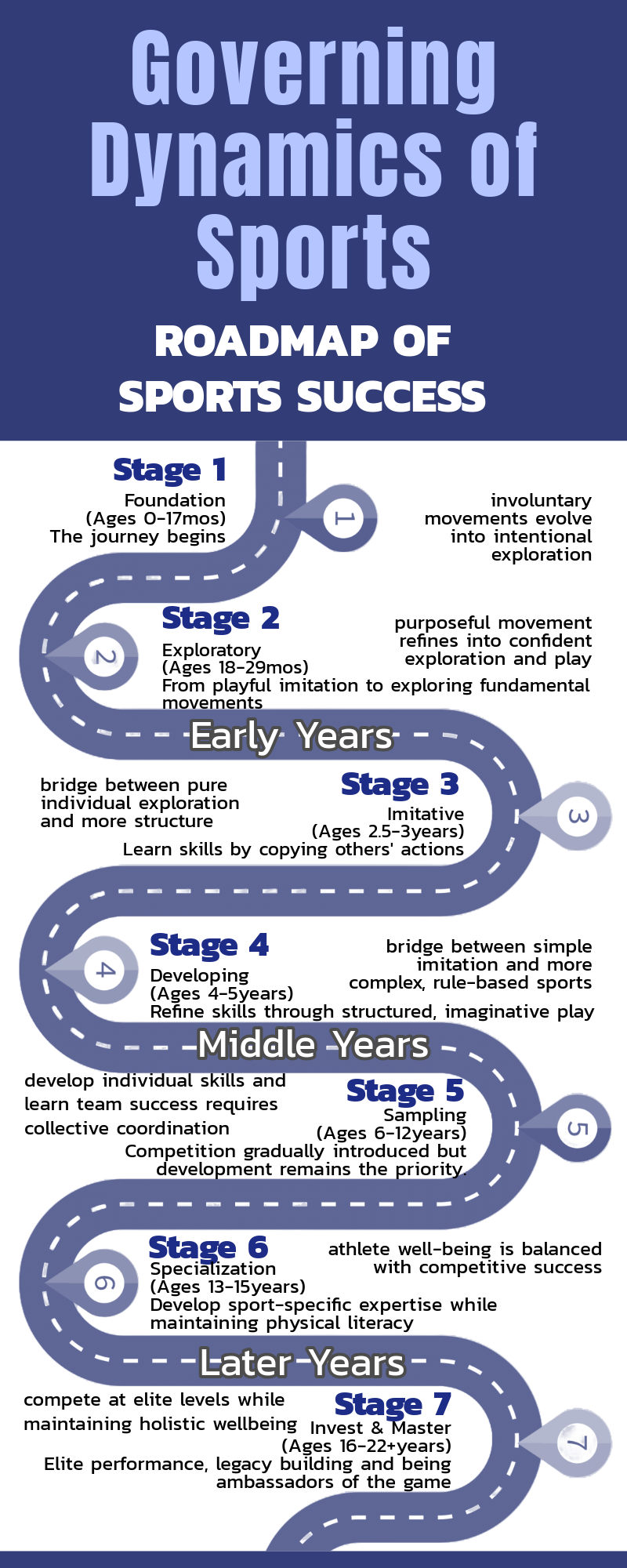
5. GOVERNING DYNAMICS OF SPORTS© ROADMAP (Kayden, 2025)
Application: Master framework connecting all developmental stages
Seven Stages: Foundation (0-17mo) → Exploratory (18-29mo) → Imitative (2.5-3yrs) → Developing (4-5yrs) → Sampling (6-12yrs) → Specialization (13-16yrs) → Investment & Mastery (16-22+yrs)
Three Developmental Periods: (Non-competitive) Early Years, Middle Years, Later Years
Dr. Kayden's Use: The complete roadmap showing natural developmental progression and revealing the three "danger zones" where traditional youth sports violate proper development. This visual makes immediately clear why starting at age 6 (Côté's arbitrary designation) skips four critical foundational stages.
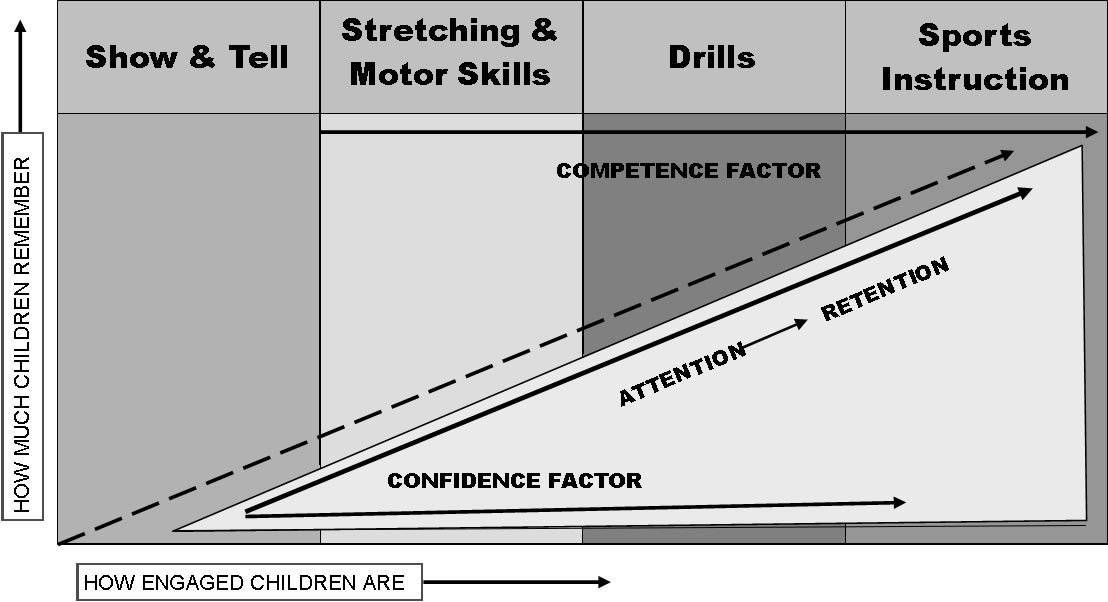
3. SPORTS INSTRUCTIONAL MODEL (Kayden, 2013)
Application: The Jelly Bean Way© effectiveness demonstration
KeyComponents:
- Horizontal axis: How Engaged Children Are
- Vertical axis: How Much Children Remember
- Progression: Show & Tell → Stretching & Motor Skills → Drills → Sports Instruction -
Two factors: Confidence Factor (bottom) and Competence Factor (middle)
- Outcomes: Attention → Retention curves showing exponential growth with engagement
Dr. Kayden's Use: Demonstrates why traditional show-and-tell produces low retention (10-30%) while entertainment-enhanced sports instruction in the engagement zone produces higher retention (30-90%).
This model validates the non-competitive pedagogical approach underpinning The Jelly Bean Way©.
Over 20+ years of systematic implementation across multiple program contexts, Dr. Kayden's methodology has documented:
- 15,000+ families served across diverse populations including children with disabilities
- 20+ organizational partnerships including park districts, recreation centers, and school programs
- Zero serious injuries recorded over two decades of implementation
- Consistent outcomes across diverse coaching backgrounds, socioeconomic contexts, and sports environments
- Children developing coachability markers associated with long-term athletic success
- Families maintaining sustained engagement across multiple seasons
- Successful progression to age-appropriate competitive programming for those who choose it
These implementation research outcomes align with educational research showing that preschool attendance predicts later educational success. Dr. Kayden theorizes that the absence of a preschool equivalent in sports—the early learning gap he identified—may be a leading factor in understanding youth sports' 70% dropout rate by age 13.
This hypothesis requires rigorous academic study to validate, but two decades of implementation provide compelling evidence that developmentally appropriate early learning foundations change children's entire relationship with sports and movement.
The Reform Work: Beyond Typical Problem-Rhetoric
What distinguishes Dr. Kayden's work from conventional youth sports reform is his systematic analysis of root causes rather than surface-level problems. While most reformers critique coaching behavior, parental pressure, or specialization timing—all symptoms—Dr. Kayden identifies the systemic structures that make these problems inevitable.
His signature analytical approach uses parables and economic frameworks to reveal how broken incentive structures create predictable outcomes.
Implementation Outcomes
THE $5,000 GARDEN PARABLE
When a father pays premium prices for his child's garden education, economic pressure forces the gardener to abandon foundational teaching (slow, invisible work like learning to read soil) in favor of impressive visible results (perfect vegetables the child didn't actually grow). The child learns nothing transferable because the economic model eliminated the foundation-building that justifies the investment.
This same pattern explains youth sports' failures: tournament economics optimize for traveling families paying premium prices, not for childhood development. The business model eliminates foundations because they're invisible, slow, and don't produce impressive short-term results that justify high costs.
Dr. Kayden's frameworks trace youth sports' most persistent problems to their systematic origins:
ATHLETE SUVIVOR BIAS
The 30% who succeeded despite the system now control it, psychologically unable to acknowledge its flaws due to cognitive dissonance.
TOURNAMENT HOSPITALITY ECONOMICS
Youth sports generates $40+ billion optimizing for traveling families, not childhood development. The business model requires outcomes that justify premium pricing, eliminating invisible foundational work.
THE EARLY LEARNING GAP
Sports science's foundational blindspot left ages 0-5 unstudied, creating a system that skips foundations entirely and enters children at competitive levels (age 6) before developmental readiness.
SMITH VS NASH
Youth sports operates on Adam Smith's incomplete 1776 theory (individual competitive advantage creates optimal outcomes) rather than John Nash's 1950 correction (optimal outcomes require balancing BOTH individual advantage AND collective wellbeing).
This shifts the conversation from "how do we fix bad coaches?" to "why does the economic model select for coaches who prioritize winning over development?" From "how do we reduce specialization?" to "why does the business model require early specialization to sustain itself?"
The Athlete Survivor Phenomenon
One of Dr. Kayden's most significant contributions to understanding youth sports dysfunction is identifying the Athlete Survivor Phenomenon—the mechanism that perpetuates bias and broken systems across generations.
THE PATTERN:
The 30% of children who survive youth sports systems become coaches, administrators, and researchers who perpetuate those same systems. Having succeeded within existing structures, they experience cognitive dissonance when confronted with evidence that their beloved system fails 70% of children. Their survival story becomes their identity—questioning the system feels like questioning their own worth.
This creates a perpetuation mechanism: survivors design the next generation of systems guaranteed to produce another 70% casualty rate, not through malice, but through structural psychological blindness.
THE METHODOLOGICAL CONSEQUENCE:
Traditional sports science research is backwards-looking by design: it starts with elite performers (Athlete Survivors) and works backward only to age 6. This approach can see the 70% dropout rate clearly—the problem is visible. What it cannot see—what it is structurally incapable of seeing—is that the 30% who survived are creating the next generation of systems guaranteed to produce another 70% casualty rate.
Backwards-looking approaches study effects but stop before reaching causes. Early Learning Sports Development was established as the first forward-looking, bidirectional discipline in sports—capable of seeing from birth to elite and back again—precisely because it was founded outside the constraints of Athlete Survivor research architecture.
Why Dr. Kayden's Work Matters
Traditional youth sports conform children to fit sport. Dr. Kayden's approach conforms sport to fit children—what he terms the shift from the "Golden Rule" (backward thinking) to the "Platinum Rule" (forward thinking in natural developmental order).
This isn't merely theoretical: it's been implemented with 15,000+ families over 20+ years, producing documented outcomes in coachability development, family engagement, and successful progression. However, the critical hypothesis—that proper early learning foundations prevent rather than attempt to fix the 70% dropout crisis—requires academic validation through rigorous prospective study.
Dr. Kayden's unique contribution is bridging the gap between the excluded early learning phases between ages 0 to 5 years. He has well-documented dropout problem (70% by age 13). His frameworks provide the missing infrastructure that sports science never developed, creating both the theoretical foundation and practical implementation models that can now be studied systematically.
His work operates outside commercial constraints by targeting the operable birth to 5 year formal introductory window before tournament economics establish dominance, before pyramid structures reach families, and before competitive pressures complicate development. This positions early learning as the structural intervention point that can address youth sports' systemic failures—not by reforming the existing system, but by building proper foundations before families enter it.
Current Work & Future Direction
Dr. Kayden began working in the early childhood sports industry in 2006, at a time when Google searches returned no results for coaching early learners—literally nothing. In 2009, he founded his Chicago-based early learning sports, instruction, production, and research Company, Coach Pickles’ Jelly Bean Sports. In 2010, he incorporated Jelly Bean Sports, Inc. and has spent the years since proving that babies, toddlers, and preschoolers not only belong in sports, but represent its missing foundation.
He still teaches classes, shares systematic analysis through articles via his website, www.bradkayden.com, www.jellybeansports.com, and www.coachpickles.com (coming soon!) and on LinkedIn. He publishes video content regularly on YouTube across three channels: www.youtube.com/@jellybreansports, www.youtube.com/@thecoachpickles, www.youtube.com/@dr.bradley.j.kayden
His forthcoming book, *151 Ways to Teach Preschoolers Sports and Keep Them Begging for More* (Fall 2026), distills two decades of implementation research into practical methodology for parents, teachers, and coaches working with early learners.