What Is Making Kids Coachable©?
Traditional coaching assumes children need to be coachable before instruction can be effective. Making Kids Coachable recognizes that coachability itself is the outcome — and that the outcome is not constructed. It is preserved.
Every Coach Depends on This
Every form of coaching that exists — at every level, in every domain — operates on the same assumption: there is something within the person that the coach helps access.
The executive leadership coach doesn't install leadership into a CEO. They draw out the decision-making clarity that's already there. The elite performance coach doesn't build greatness into a world-class athlete. The best ones talk about getting out of the athlete's way. The nutritional coach, the strength coach, the therapist, the vocal coach — all of them are working with what's within.
The entire coaching profession depends on one prerequisite: the person being coached must be receptive, trusting, willing to be guided, and open to correction without shutting down.
That prerequisite has a name. It's coachability.
Nobody has traced it backward. Why can one executive take direct feedback and grow while another shuts down? Why does one athlete thrive under coaching pressure while another crumbles?
The standard answer: personality. Grit. Mental toughness.
Making Kids Coachable offers a different answer: coachability is not a personality trait. It is a preserved developmental state. The executive who receives feedback openly at 45 is drawing on a capacity that was either preserved or destroyed before age 5.
Every coach at every level is downstream. Making Kids Coachable works at the origin.
Four Independent Fields Confirm the Same Thing
The preservation claim is not theoretical. Four independent evidence streams — from motivation science, developmental psychology, elite performance, and market economics — converge on the same conclusion.
Motivation science. Deci and Ryan's Self-Determination Theory (1985, 2000) — cited over 80,000 times — identified three psychological needs they explicitly describe as innate, universal, and congenital: autonomy, competence, and relatedness. Not learned. Not constructed. Present from birth. Their central empirical finding: controlling environments undermine intrinsic motivation. Systems destroy what was already there.
Their plant metaphor is preservation language: deprive a plant of sunlight, water, or soil and it withers. Deprive a child of autonomy, competence, or relatedness and motivation dies. You didn't fail to build it. You killed what was growing.
Developmental psychology. Fonagy's research on epistemic trust — the innate mechanism by which humans trust their informants and become receptive to learning — establishes that this capacity is present from birth, facilitated by secure attachment, and central to every educational and therapeutic relationship for life.
Epistemic trust is coachability by its clinical name. When preserved through early relational experience, it enables learning across every domain. When damaged, it undermines every coaching, teaching, and therapeutic relationship that follows. The $500-an-hour executive coach is working with whatever epistemic trust survived childhood.
Elite performance. Navy SEALs, Formula 1 drivers, Olympians, and corporate executives pay neuroscientists millions to recreate specific training conditions: visual occlusion, unstable surface practice, sensory deprivation, balance perturbation protocols. What they're recreating are the exact physical constraints that characterize early learner movement — the wobbling, the struggling, the incomplete coordination that sports research spent 60 years dismissing as "not ready." Same constraints. Opposite conclusions.
Sports research said: eliminate these conditions. Elite training said: recreate them at enormous cost. Early learners naturally develop the cognitive architecture — adaptability, problem-solving, learning receptivity — that elite performers pay to recover. The qualities aren't just psychological. They're neurological. And they were always there.
Market economics. The global coaching industry generated $5.34 billion in 2025. Executive coaching and leadership development: $103.6 billion, projected to reach $161 billion by 2030. Seventy percent of Fortune 500 companies use executive coaching. That's a $100+ billion industry built on one premise: accessing what's within the person being coached. Every dollar spent is a dollar spent working with whatever coachability survived childhood. The industry exists because preservation failed at scale and recovery is expensive.
Deci and Ryan give you the empirical foundation. Fonagy gives you the clinical mechanism. Elite performers prove the neurological reality. The market gives you the price tag. All four say what Making Kids Coachable says: it was always there, systems destroyed it, and recovery is either expensive or impossible.
The Preservation Reversal
If every coach is working with what's within, then the question becomes: who is responsible for preserving what's within before the first coach ever arrives?
Every major early childhood methodology — Montessori, Reggio Emilia, Vygotsky — assumes the adult builds something in the child. Making Kids Coachable inverts this.
The adult's primary role is not to build. It is to not destroy what's already there.
The Coachability Staircase©
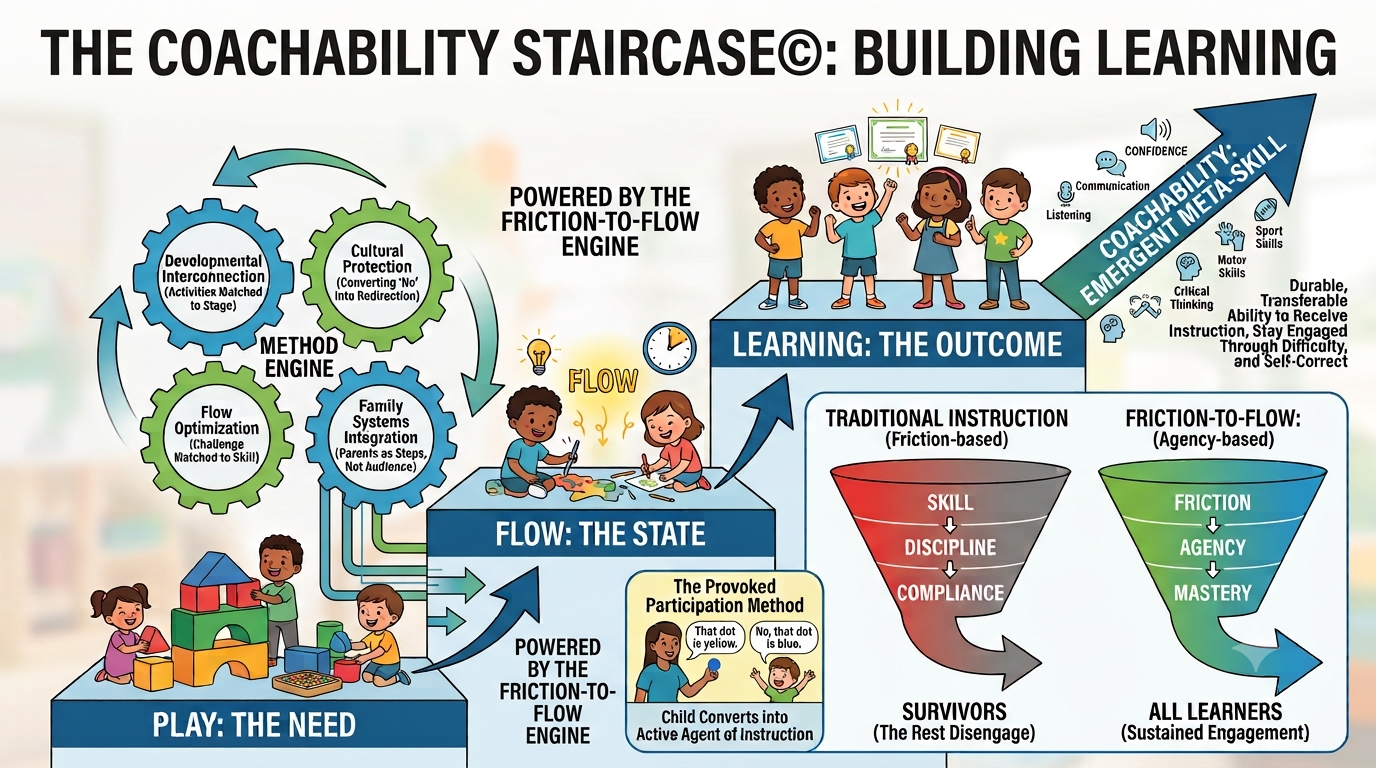
Preserving coachability has a process that is largely about moving friction-to-flow
The framework's architecture is the Coachability Staircase — a three-step developmental sequence with a four-dimension engine driving the ascent.
Play is the need. Not the reward for learning. The foundational state from which everything else becomes possible.
Flow is the intentional landing. The state in which coachability is most accessible — a child who is genuinely engaged is neurologically and emotionally available to learn.
Learning is the outcome. Not the input. The thing that emerges naturally when play and flow have done their work.
The engine driving the ascent has four non-negotiable dimensions:
Developmental Interconnection (activities calibrated to the child's actual stage),
Cultural Protection (shielding from competitive pressure before it takes root),
Flow Optimization (sustained engagement through humor, novelty, and developmental precision), and
Parent Integration (parents as co-learners and emotional anchors — the structural condition that makes the entire system work). Pull any one and the circuit collapses.
When the engine runs, five foundational components emerge simultaneously:
listening,
communication,
critical thinking,
motor skills, and
sports/physical skills.
These are not instructional targets. They are outcomes that appear when the preservation system functions.
Catch the Coach
Parents call the method in action "Catch the Coach." The coach calls yellow "blue." Children erupt: "No! That's YELLOW!" The coach demonstrates a shot with the wrong hand. Children rush to show the right way.
Underneath it sits the Provoked Participation Method — an architecture powered by intentional error, expectation violation, and authority inversion. The child enters flow through the act of correcting the adult. This is relational flow — generated between two parties, not arrived at by one alone.
The deeper treatment of the Coachability Staircase — including the nature of the landing, the relational flow claim, and the evidence base — is being published in the current ECE series on this platform.
Two Fields, One Engine
Making Kids Coachable was born inside Early Learning Sports Development.
But the Coachability Staircase and the four-dimension engine are not sport-specific.
They preserve a child's capacity to receive instruction across any learning domain — giving rise to Early Learning Physical Development as a parallel field. Same engine. Same staircase. Different application domain.
Why It's Called "Making" When It Should Be "Keeping"
The framework is called Making Kids Coachable. It should have been called Keeping Kids Coachable. The name was chosen in 2013, before the preservation paradigm was fully articulated — before twenty years of implementation revealed that the adult's role is not to construct coachability but to stop destroying it.
That the founder of the preservation paradigm named his own framework using constructionist language tells you everything about how invisible the assumption is. If I couldn't escape it, no one in sports or education has. The name stays — it's published, trademarked, indexed, and recognized. But the irony is worth naming because it IS the argument.
And this evolution — from "making" to "keeping," from construction to preservation — is precisely what distinguishes this work from what the two fields it bridges are currently doing.
Early childhood education engages in what amounts to creative curating — assembling pedagogical approaches, refining classroom environments, iterating on methods — but within a constructionist paradigm that has never been fundamentally questioned. The assumption that the adult builds something in the child remains unchallenged. The curation gets more creative. The foundation stays the same.
Youth sports engages in problem rhetoric — documenting dropout rates, publishing burnout studies, naming abuse patterns, calling for reform — without providing the structural frameworks that would make reform possible. Sixty years of naming what's wrong. Zero authoritative models for what's right.
Making Kids Coachable — and by broader definition, the Natural Order of Sport© and Physical Development — provides what both fields are missing: evolutionary thinking. Not curating within an unquestioned paradigm. Not naming problems without solutions. Evolving the foundational assumptions themselves based on what implementation reveals over time. A framework that names its own contradiction, explains why it happened, and uses the discovery as evidence for the depth of the problem it addresses — that is a framework that is alive, not frozen in 2013.
The Question That Changes Everything
Traditional assessment asks: "Is this child coachable?"
Making Kids Coachable asks: "Is our program preserving coachability?"
That reversal determines whether the $500-an-hour executive coach forty years from now is working with a full reservoir — or with whatever survived.
We have spent a generation standing at the top of the staircase shouting "learn!" while kicking out the steps underneath. Then we call the result a crisis.
The adult's job was never to install coachability. It was to stop kicking out the steps.
Dr. Bradley J. Kayden developed Making Kids Coachable© through doctoral research (Argosy University, 2013) and 20+ years of implementation. The Coachability Staircase© was formally articulated through the ECE series (2026).
Full article at bradkayden.com/jelly-bean-way - The Making Kids Coachable framework is embedded within The Jelly Bean Way©️