Jerry Seinfeld and Larry David built the biggest comedy in television history on one rule. It took me twenty years with three-year-olds to understand what it was really about.
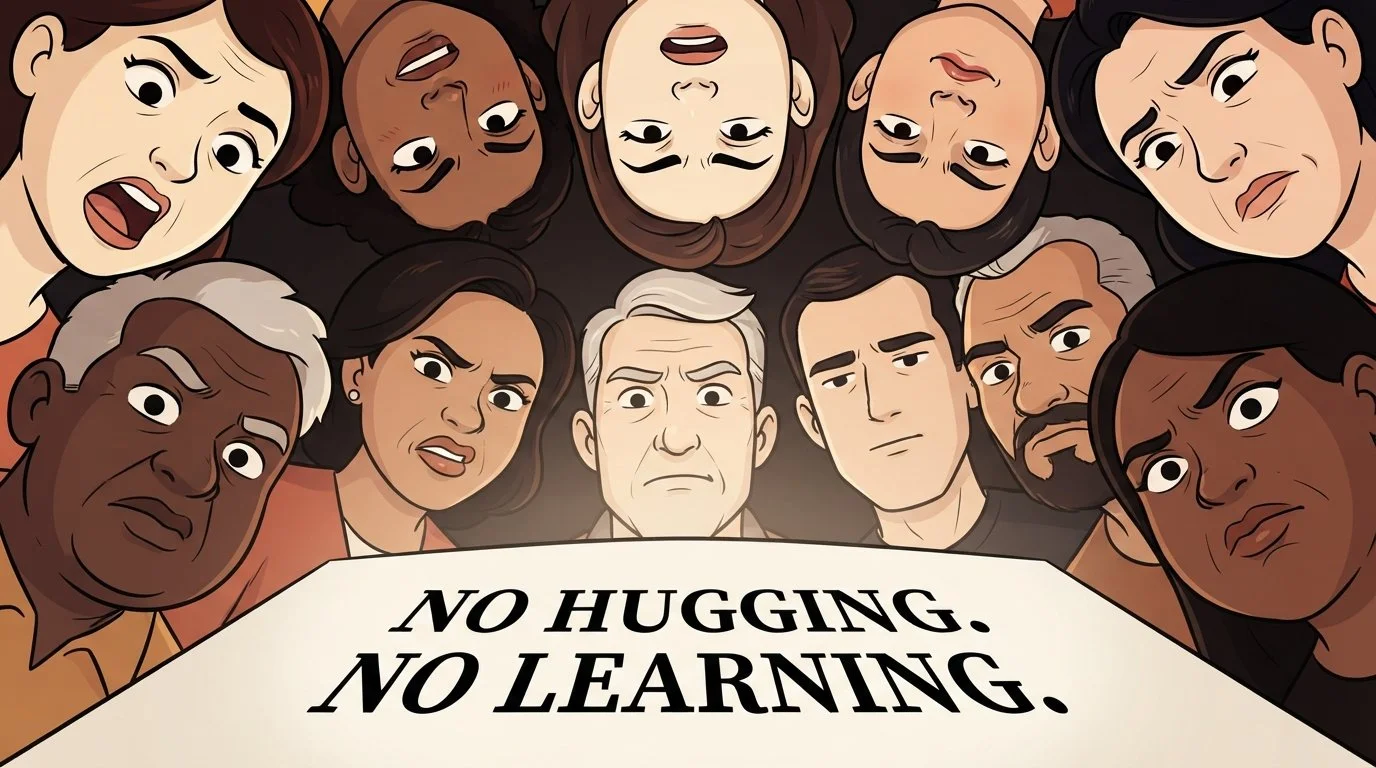
The rule was: no hugging, no learning.
Nobody reconciles.
Nobody grows.
George does the wrong thing, lies about it, makes it worse, learns nothing, and does it again next week. Freeze frame. Credits. Nine seasons without letting a single character improve.
I've spent two decades teaching sports to three- and four-year-olds. When somebody explained that rule to me recently, I said it out loud: that's genius.
Which probably needs explaining, so let me start with the show and come back to the children.
What They Were Actually Banning
Before Seinfeld, every sitcom ended the same way.
Soft piano. Somebody sits on the edge of a bed. A lesson gets delivered — about honesty, about trying your best, about what we all learned today — and the audience is told, clearly, what to feel about it.
These were puritanical dramas with jokes dropped in. The comedy wasn't the sizzle. It was the seasoning. The structure underneath wasn't instruction. It was emotional management.
Seinfeld and David banned the piano. The bedside chat.
And in doing so, the lesson was delivered anyway — just not by them.
Watch four people behave badly for twenty-two minutes with nobody telling you how to feel about it, and you supply the verdict yourself. You recognize the pettiness because you've done it. Nobody had to say so, and because nobody said so, it stuck. That's the contrast in one line: the old sitcom handed you a moral. Seinfeld made you produce one.
Studio executives hated it. A comedy where nobody is likable — their words — where nobody improves and nothing resolves, violated everything television believed about why people watch. The network nearly killed it more than once.
They were wrong about the likable part, and spectacularly so. Thirty years on, people still love those four. They love them for precisely the reason the executives objected: nobody ever made them better.
But the ban bought them three things, and each one came from a place other than the mass-audience television domain they were serving — the comedy stage.
It let the audience be flawed. Traditional sitcoms asked you to identify with good people learning lessons. Seinfeld asked you to identify with pettiness, social anxiety, and grievances too small to admit to. Everyone has lied to escape a dinner. Everyone has obsessed over a parking space. Because the characters never learned to be better, the show became a safe place to recognize yourself without being improved.
It gave every second back to the joke. No tonal shift at minute eighteen. No emotional processing. Twenty-two minutes, all of it spent on what you came for — and because nobody evolved, the show reset weekly. You could enter at any episode, in any order, and miss nothing.
It made room for a structure nobody else could pull off. With the time saved, Larry David ran four plots at once — each character starting with their own small, ridiculous problem, all four colliding in the final minutes into a single catastrophe. Nothing was filler. The payoff only worked because the setup never announced itself.
Underneath all three was one idea, and they'd both learned it standing in front of live rooms long before television: the people watching are smart. You don't have to tell them what to feel. They're already in on it.
That idea — not the cynicism, not the characters — is why the show still works thirty years later.
The Airing of Grievances
Because the two things Seinfeld banned are the only two things youth sports reliably delivers.
The hug. And the lesson.
The hug after the game isn't for your kid. Neither is the lesson on the drive home.
The hug is for our egos, the need to have been part of it. The lesson is the receipt — the Saturday given up, the drive, the snacks, the standing in the cold. We need something measurable to show for it.
The trophy. The speech. The "good hustle out there, bud."
That is adults managing adult feelings, using a child as the equipment.
Thirty years ago, children just played. Without adults intervening. No hugging. No lesson.
And the thing we've never extended to a four-year-old is exactly what Seinfeld extended to thirty million adults every Thursday: the assumption that they're smart, that they were there, and that they don't need us to tell them what it meant.
We don't trust a child to have had a good time in youth sports unless we narrate it for them during, and back to them afterward.
There is an alternative. It is slightly ridiculous, it comes from the same place the show did, and I'll get to it.
Yada Yada Yada
Yada yada yada is how you skip the part that actually mattered.
Sports science set the entry point into sport at age six. Not because sports development begins at six — it begins at birth, as the Natural Order of Sport has determined.
That's the yada yada yada. Sports science glossed over it because six is roughly when children become teachable by the traditional coaching methods adults already use.
So we never studied how children learn sport. We studied when they start tolerating how we teach. Those are different questions, and answering the second left the first untouched.
Which means youth sports, underneath everything, is guessing.
Ask a coach why a session runs the way it runs and the answer is almost never evidence. It's that this is how it's done. I've written before about Youth Sport's Frankenstein, where Steve Jobs named the mechanism exactly:
"In business, a lot of things are — I call it folklore. They're done because they were done yesterday and the day before. Nobody knows why they do what they do. Nobody thinks about things very deeply."
He was describing business, but so many other things besides — youth sports among them.
The Contest
Last week, the Milwaukee Brewers won the 2026 World Series — their first — with a payroll a fraction of the clubs they beat. They didn't out-slug anybody. They won on contact, plate discipline, defense, and a bullpen nobody could solve. A development philosophy, run against organizations who believe money buys the talent that produces the all-important October wins.
Pat Murphy, their manager, at sixty-seven:
"I gotta be a little mindful how I treat these guys. This profession isn't about the wins and losses. This profession is about how do I impact this person. How do I make this person believe they're better than they are."
A Major League manager describing his job as human development rather than outcome — and then winning the whole thing.
If it works at the top of the sport, somebody owes us an explanation for why it can't work at the bottom.
The Opposite
George's best episode is the one where he does the reverse of every instinct he has, and everything finally goes right.
That's our coaching method at Jelly Bean Sports, more or less.
Working at the introductory levels of sport, our coaches hold the bat wrong on purpose. Hands apart, knuckles crossed, the whole thing backwards. Then they wait.
It takes about three seconds before at least one child gets to their feet, yells “No!” and walks up to say, "That's wrong!"
Like Seinfeld, I have always taught our coaches that the gym floor is a stage. When you walk onto a stage you leave your troubles at the door. You play a role. You become a character. And that role entails elicitation — using a wrong statement instead of a question, because correcting someone feels like winning, while answering a question feels like a test.
Reversing expectation was Seinfeld's greatest gift. Coaching mastery demands the same thing, and at its core, it is human development.
A question demands production. A wrong statement only demands recognition.
"What color is this ball?" puts you in charge. There is a right answer, you already know it, and the child is performing for your approval.
"This is a purple ball," when it is yellow, puts them in charge. The child notices the error and fixes it instinctively, using whatever knowledge they've been given up to that point. And fixing an adult is thrilling rather than exposing.
The technique also scales, which is the part that surprised me. Tell an informed athlete the wrong thing about a skill they already own. In seconds you can assess how well they're listening, how much they've retained, and whether they'll say it out loud in front of their teammates.
Reverse their expectation — you know the one, from being an athlete yourself, that the coach knows everything — and watch them engage, because now there's a record to correct. And you're testing their resolve before asking them to have it on the field.
You can call it a joke. You can call it a test. Either way it's doing real psychological work. We call it building a mental sweat.
Which is Seinfeld, applied to sports development.
That's one instrument. There are others, and twenty years of writing them down.
The Finale
Seinfeld ran four seasons before most of America noticed it. Too strange, too cold, too unwilling to hand audiences the ending they'd been trained to expect.
Then it became the most profitable half hour in the history of television, and the Writers Guild named it the best-written series ever made.
All of it downstream of one decision: trust the audience.
So stop announcing the lesson and let them play a part in producing it.
Learn how to entertain. Be ridiculous, and watch how your audience learns.
It mirrors old-fashioned learning through play. When children were not led by adults, they challenged one another at every turn. Possession was the name of the game.
So teach through challenge. Directly — take their ball, say it's my ball, and make them fight to get it back. Indirectly — be wrong on purpose. Do what doesn't demand a lesson.
Sure, it sounds reckless. It is the opposite of reckless. Like Larry David did with the sitcom, we have to throw out the old way of thinking that says we know everything and children know nothing. When you understand what motivates children, you understand how children learn.
Take it from me: humor greases the cogs. Completely.
This is coaching mastery, and mastery is what makes a rule breakable. Every other coach is guessing at what children want and splitting the difference with a lesson. You would know how children learn.
Knowing doesn't make every child the same. It doesn't make thinking rigid. Knowing what drives a child is what lets you do more with them — which is the only reason Larry David could break the rules with his audience.
So if you teach children anything — a sport, an instrument, a kitchen table full of homework — the foundation is already sitting in nine seasons of a show about nothing.
Ban the lesson. Trust the room. Be wrong on purpose.
How would Larry David run a class for three-year-olds?
He'd throw out the lesson. He'd keep everything simple, and structured broadly identical every week. He'd be wrong on purpose and let them catch him. He'd trust the audience to be in on it.
He'd be the best coach in the building, and not one parent would understand why.
What did your kid actually learn at practice last week?
Be honest — and then ask whether that was ever the point.
— Dr. Bradley J. Kayden, founder of Early Learning Sports Development and Coach Pickles' Jelly Bean Sports. Read more at www.bradkayden.com.
Seinfeld structural analysis draws on the Acquired podcast's October 18, 2026 episode. "No hugging, no learning" is attributed to Larry David.
#EarlyLearningSportsDevelopment #YouthSports #Seinfeld #Coachability #EarlyChildhood #CoachPickles #JellyBeanSports
Common Questions
Why do so many children quit youth sports?
Roughly 70% of children leave organized sports by age thirteen. The common explanation is lack of talent or interest. A structural explanation is that youth sports was never built around how young children actually learn — it was built around when children become teachable by methods adults had already chosen. Children who never developed intrinsic motivation, movement literacy, or coachability in the foundational years arrive at competition without the qualities that would sustain them in it.
At what age does athletic development begin?
Athletic development begins at birth, not at age six. Sports science set the entry point into sport at six because that is roughly when children can tolerate conventional coaching instruction — not because development starts there. The years from birth to five, when coachability, love of the game, and a positive attitude are either protected or lost, fall outside every major talent development model.
What is elicitation in coaching?
Elicitation is the use of a deliberately wrong statement in place of a question. Asking a child "what color is this ball?" puts the adult in charge — there is a right answer, the coach already knows it, and the child performs for approval. Saying "this is a purple ball" when it is yellow puts the child in charge: they notice the error and correct it. Correcting an adult is engaging rather than exposing, and it produces communication, critical thinking and listening in a single moment without any of them being instructed.
Should coaches teach lessons to four-year-olds after a game?
The postgame lesson is generally for the adults rather than the child. A four-year-old cannot hold an abstraction like "effort matters more than outcome" as a portable idea, and narrating the meaning of their experience back to them replaces their version with an adult's. What young children need from a session is engagement, humor, and a reason to return — not a moral.
What is Early Learning Sports Development?
Early Learning Sports Development is the field addressing structured athletic development for children from birth through age five — the foundational period before organized competitive sport begins. It is distinct from kinesiology, which asks when children are ready for sport, and from traditional youth sports, which begins at age six. It asks instead how children in these years actually learn.